Rohin Malhotra
A smart kitchen is what you get when connectivity and computation show up in the places you actually cook. Appliances can take instructions, report back, and in the more interesting cases, make small decisions while dinner is happening. It is not a single box you uncrate. It is the moment your kitchen has enough parts that can communicate, react, or act on what is happening to the food inside them.
"Smart kitchen" gets slapped on everything from a Wi-Fi coffee mug to a refrigerator with a touchscreen. That vagueness is exactly why the phrase has started to rot. When the same label covers a $30 plug and a $3,000 appliance, it stops helping you decide what to buy.
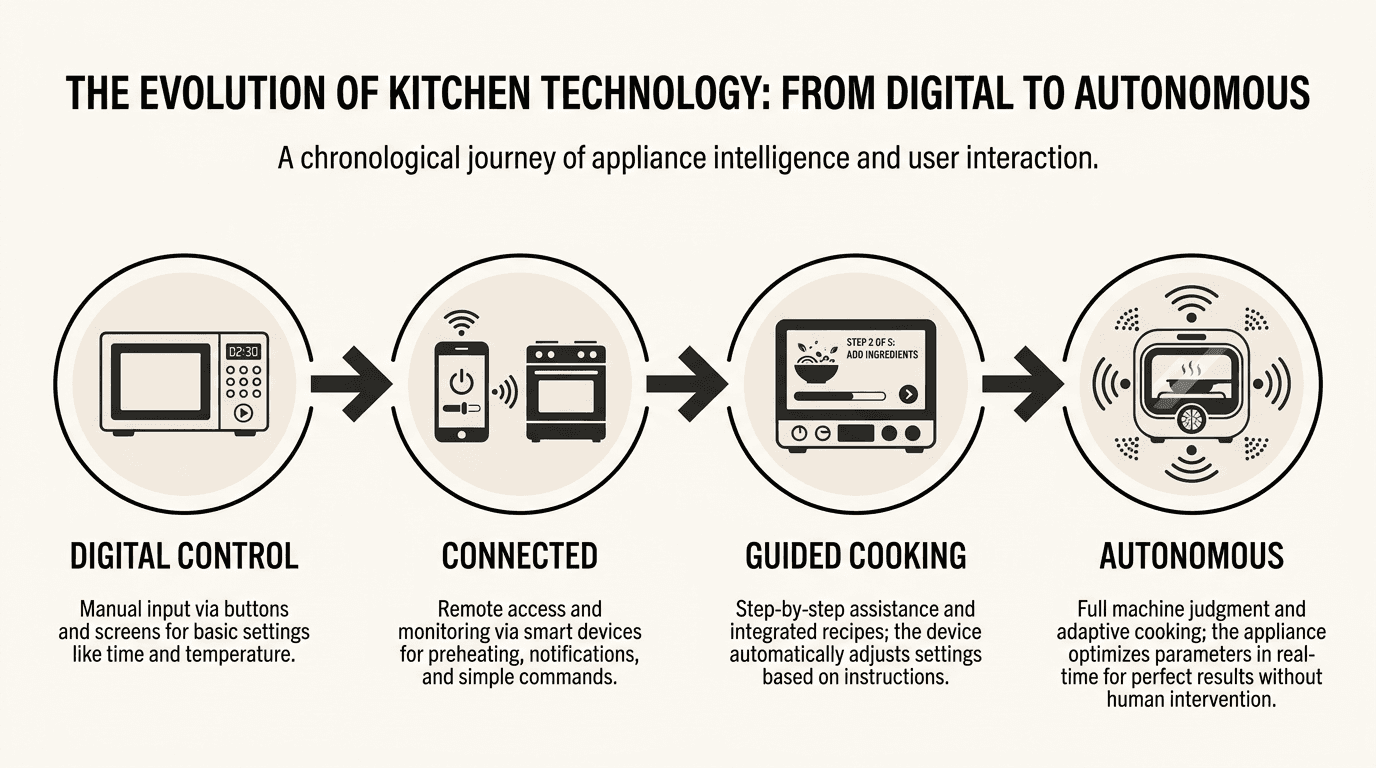
Rather than litigate which gadget deserves the badge, this guide uses a cleaner lens: four generations of kitchen tech, sorted by what the machine actually does at dinnertime. Put a device in the right generation, and the marketing haze clears; you can see what it changes about your evening, if it changes anything at all.
The Four Generations of Kitchen Technology
Most kitchens are already mixed. A Gen 1 microwave can live happily next to a Gen 2 smart speaker, next to a cast-iron pan that has never needed a firmware update. "Smart" is not a room-wide upgrade you toggle on. It is a spectrum, and the useful question is not "Is my kitchen smart?" It is "Which generation are my appliances in, and does moving up a rung actually make dinner easier?"
This four-generation frame is the only kitchen-tech conversation starter I trust, because it forces the device to show its work. It separates what a product says on the box from what it takes off your plate on a Tuesday night. Other pieces in this series lean on it, so it is worth getting it straight.
Generation 1: Digital Control
This is the microwave with the keypad, the oven with the digital temperature readout, the rice cooker with a timer. You supply every parameter: time, temperature, mode. The appliance does exactly that, and then it stops. It does not know what is inside. It does not adjust. It is dependable in the way a stopwatch is dependable: accurate, literal, and oblivious.
Gen 1 is the floor for a modern kitchen, and it earns its keep. A programmable slow cooker changed weeknight stews for millions of households. Still, calling it "smart" is a stretch. It is digital control, not machine judgment.
Generation 2: Connected Kitchen Appliances
Gen 2 is where "smart" starts showing up on the label and where the word starts getting abused. A Gen 2 device is online, usually via a phone app. You can preheat the oven from the car, check whether the dishwasher finished, or get a ping that the fridge door has been open for ten minutes. The feature set is remote control plus status updates.
This is the bulk of what you see sold as smart kitchen appliances. The connectivity is real and can be genuinely useful. However, the appliance is still waiting for you to tell it what to do. It does not necessarily understand the food or adjust the cooking process on its own. A connected oven you forgot to load is still just a hot, empty box you turned on from a parking lot. To understand how a system that manages multiple cooking stages differs, read what an automatic cooking machine actually does at dinner.
Generation 3: Guided Cooking
Gen 3 changes the relationship. Instead of you driving every setting, the recipe drives the machine. A guided system pairs step-by-step instructions with direct control of time, temperature, and cooking modes. You follow prompts and add ingredients when it tells you to.
Thermomix is an example of guided cooking: its recipe platform presents step-by-step instructions while automatically setting variables such as time, temperature, and speed. Tovala takes a scan-to-cook approach, loading a predefined oven cycle from a meal's QR code or barcode. Both reduce manual settings, but they generally guide the user through a recipe or execute a chef-programmed cooking cycle. Posha goes further for supported stovetop recipes by using camera and temperature input to monitor cooking stages and manage heat, stirring, and ingredient timing as the dish progresses. For a broader comparison, see how robot chefs differ from meal kits and smart ovens.
Info: The shift from Gen 2 to Gen 3 is the biggest practical leap for most households. It is the difference between an appliance that can be controlled remotely and one that knows what it is supposed to be cooking.
The catch is that guided cooking is still, well, guided. In many guided systems, the appliance primarily follows predefined recipe settings rather than continuously judging the food itself. If ingredients behave differently from expected, the system may still depend on the user or its programmed recipe logic rather than visual feedback from the food. In those cases, the appliance primarily follows its programmed recipe logic rather than continuously adapting to visual changes in the food.
Generation 4: Autonomous Cooking
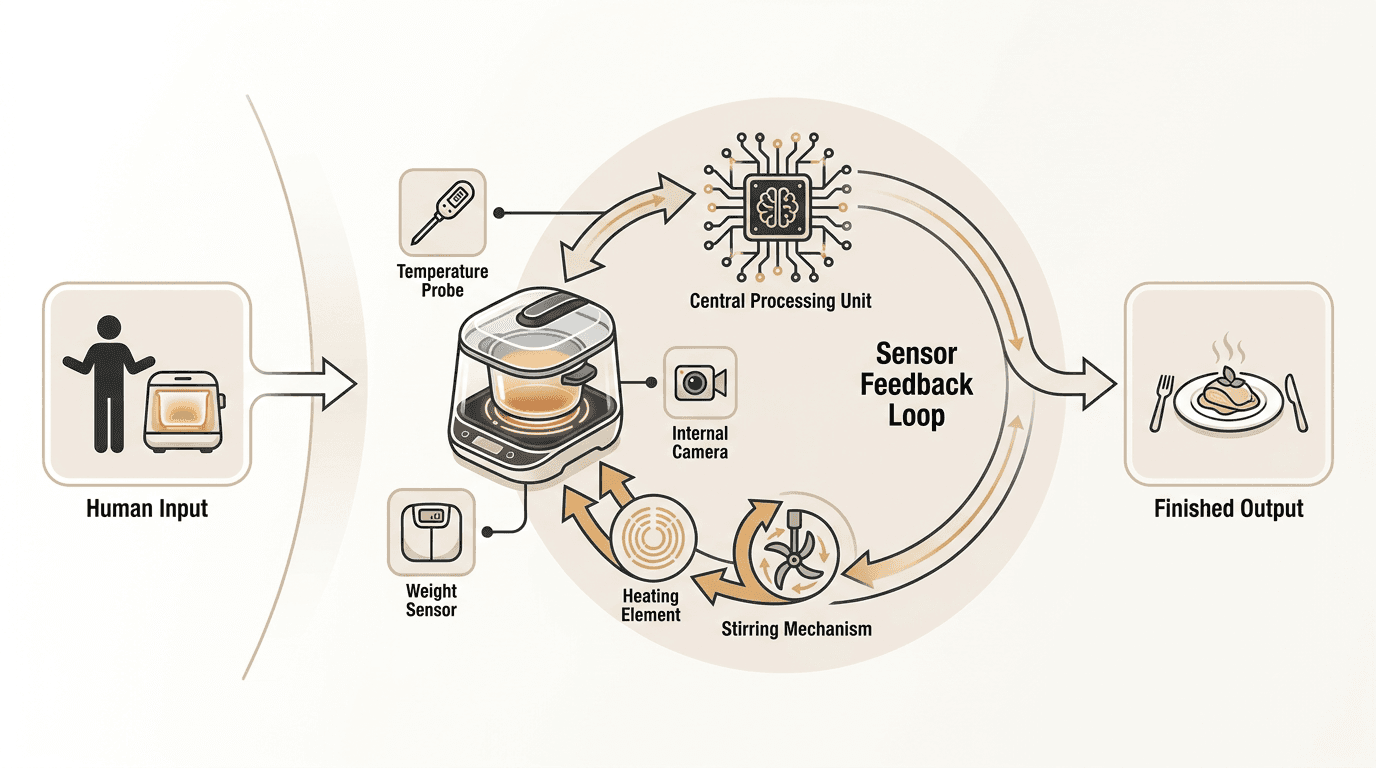
Gen 4 is where the machine stops asking for step-by-step supervision. An autonomous system can manage multiple stages and variables on its own, using sensors and computation to cook toward an outcome instead of marching through a fixed list of steps. It might sear, then braise, then hold at a precise temperature, changing its behavior based on what it is detecting in the moment. It is running a strategy, not a timer.
That requires a different kind of intelligence: Posha’s Culinary AI uses camera and temperature input to monitor how food changes during cooking. Instead of relying only on elapsed time, the system can use cooking-stage information to determine when to adjust heat, add an ingredient, or change the stirring pattern.
This is where Posha operates. After you select a supported recipe and load the prepared ingredients, Posha manages active cooking tasks such as heating, stirring, ingredient timing, and cooking-stage transitions. Its built-in camera helps it track visual changes in the food rather than treating every cook as an identical countdown. You still choose the meal, prepare and load the ingredients, and make final seasoning decisions based on your preferences. You can also see how a cooking robot manages a complete dinner.
Four Generations at a Glance
Generation | Core Technology | User's Role | Example Device |
|---|---|---|---|
1: Digital Control | Programmable timers and digital readouts | Instructor (you set every parameter) | Digital microwave, programmable slow cooker |
2: Connected | Wi-Fi, smartphone apps, voice assistants | Remote operator (you send commands from a distance) | App-controlled oven, smart plug |
3: Guided Cooking | Recipe software that directly controls hardware | Assistant (you add ingredients on cue) | Thermomix, Tovala Smart Oven |
4: Autonomous | Sensors, real-time computation, adaptive models | Curator (you choose the meal and prep ingredients) | Posha |
What a Smart Kitchen Is Not
Smart-kitchen marketing loves the idea that dinner will simply appear while you do something more glamorous. Reality is messier. Knowing what these systems do not cover is just as useful as knowing what they can automate.
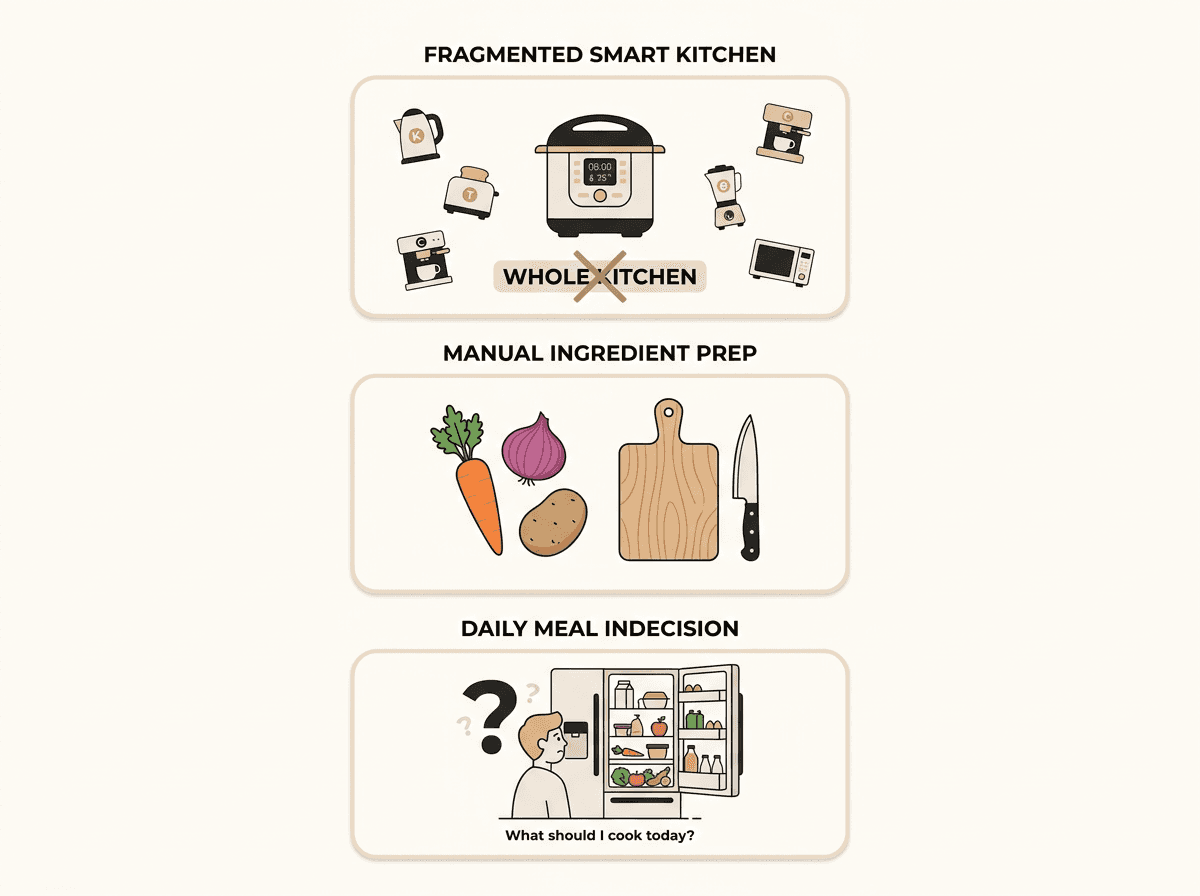
It is not a single, integrated system. You do not buy "a" smart kitchen the way you buy a car. You piece one together from whatever devices you have, often from different generations and different brands. Your Gen 4 cooker can sit next to a Gen 1 toaster and nobody gets hurt. Cross-brand interoperability is still spotty, and pretending otherwise is how you end up with three apps for three appliances.
It does not do the shopping or the prep. Getting ingredients into the machine still means washing, peeling, and chopping. Even the most autonomous system starts after you have done that part. It is also the part product demos politely skip, because a spec sheet cannot make onions dice themselves.
It does not decide what is for dinner. The final choice is still yours. A Generation 4 system can manage a multi-stage dish, but it cannot fully account for your schedule, preferences, or the cilantro going limp in the crisper. Recipe platforms may help you explore meals and organize your options, but you still decide what your household eats. Once the prepared ingredients are loaded, Posha takes over the attention-heavy parts of active cooking, including monitoring progress, adjusting heat, stirring, and managing ingredient timing for supported recipes. For a clearer picture of where the technology steps in during a typical weeknight, read what AI actually changes about cooking dinner at home.
Where Smart Kitchen Devices Stand in 2026
A 2024 forecast put the smart kitchen market on track to hit $76 billion by 2033. That figure lumps together everything from a $15 smart plug to a full autonomous cooking system, which tells you how wide the bucket has gotten. The growth is real. The label "smart" is still doing a lot of work across products that barely belong in the same sentence.
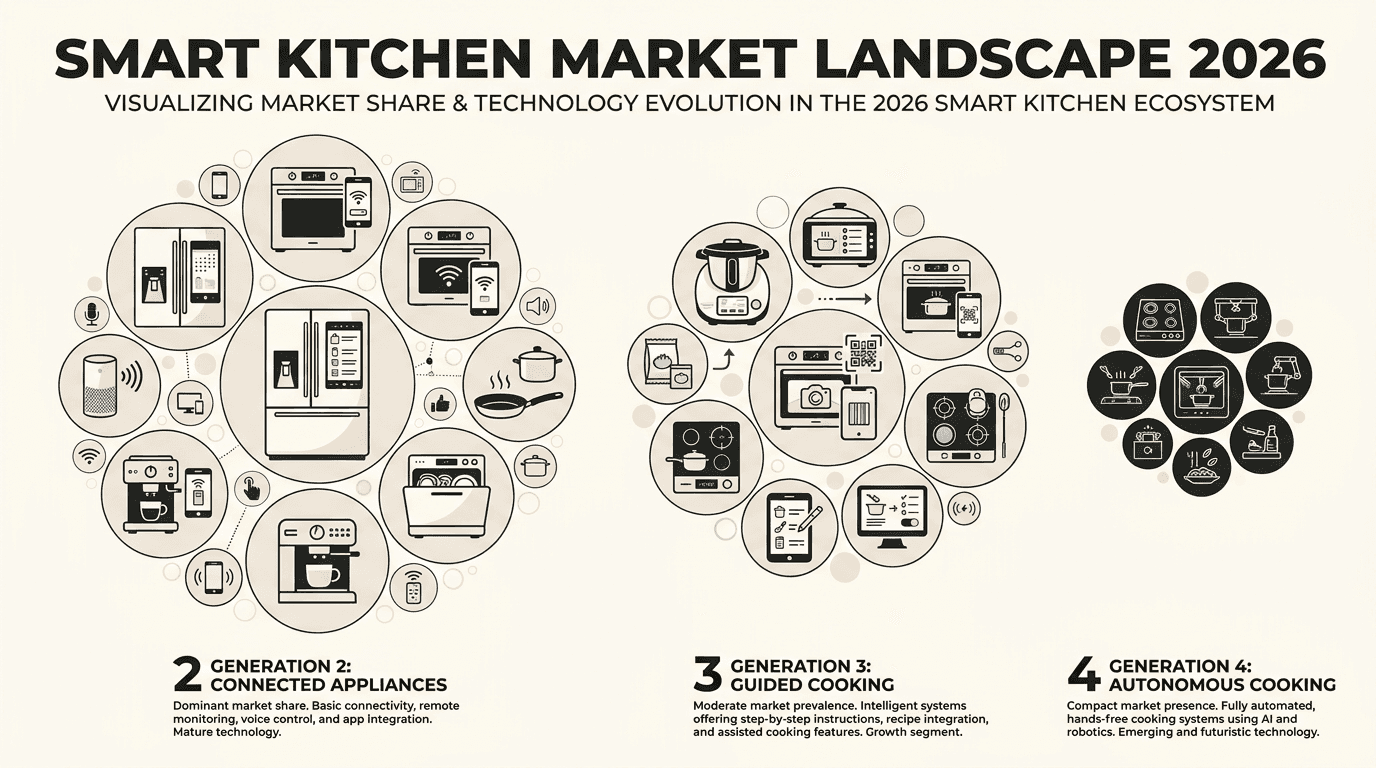
Much of today's connected kitchen equipment fits within Generation 2 or Generation 3. App-controlled ovens, smart displays, and refrigerators with internal cameras improve access to controls, recipes, or status information. Guided systems such as Thermomix and CookingPal Multo connect recipe instructions more closely with functions such as temperature, timing, mixing, and stirring. Tovala loads predefined oven cycles from meal or grocery codes, while Suvie combines scheduled cooking with refrigeration and multiple cooking modes.
These products address different needs, but Posha is designed around a different level of stovetop automation. For supported recipes, it cooks with prepared ingredients selected by the household and uses camera and temperature input to manage ingredient additions, heat, stirring, and cooking stages. That makes Posha more suitable for users who want a freshly cooked, multi-stage meal without following prompts throughout the active cook. Read more about the progression from meal delivery to automated home cooking.
Generation 4 remains a newer category than connected or guided cooking. These systems are designed to monitor cooking progress and manage multiple actions without requiring the user to enter every setting or respond to prompts throughout the cook. Posha applies this approach to supported recipes by coordinating ingredient additions, heat, stirring, and cooking stages using camera and temperature input.
Unlike a guided appliance that primarily tells you what to do next, Posha takes over the active cooking after the ingredients are prepared and loaded. Readers can browse Posha's recipe library to see the currently available dishes or read the guide to healthy home-cooked meals for busy families.
Security and Privacy: The Trade-Off Nobody Advertises
Any appliance on your home network is another place things can go sideways. Kitchen devices are not special here; they are just less expected. Connected appliances can introduce cybersecurity risks involving account access, household data, device control, and the wider home network. The National Institute of Standards and Technology (NIST) publishes IoT security guidelines that apply directly to kitchen tech, even if almost nobody reads them before pairing a new oven to Wi-Fi.
The fixes are unsexy, which is why they matter. Put IoT devices on a separate network if your router supports it. Keep firmware updated. Look up whether the manufacturer stores data locally or in the cloud, and whether it sells aggregated usage data. Those boring policy details do more to define your risk than any "secure by design" sticker on the box.
Key Takeaways: Your Smart Kitchen in 2026
A smart kitchen uses connectivity and computation to help with, or take over, parts of the cooking process. It is a spectrum, not a yes/no label.
Kitchen tech falls into four generations: Digital Control, Connected Appliances, Guided Cooking, and Autonomous Cooking.
Most products sold as smart kitchen devices today are Generation 2 (Connected) or Generation 3 (Guided).
Real autonomy (Generation 4) means the system senses the food and adjusts, rather than simply running a pre-programmed script.
A smart kitchen still does not automatically handle every part of dinner. Shopping and physical ingredient prep generally remain human tasks, while apps and recipe platforms can help with meal planning and grocery organization.
Building a smart kitchen is about picking the right level of automation for your life, not collecting the newest gadgets.
Frequently Asked Questions
What is the difference between a smart kitchen and a connected kitchen?
A connected kitchen is the narrower idea: appliances go online so you can control them remotely and see status updates (Generation 2). "Smart kitchen" is the wider umbrella, covering everything from connected devices to guided cooking systems and fully autonomous appliances. The distinction matters because "connected" is about communication, while "smart" suggests the appliance can make at least some decisions or adjustments on its own.
Do I need all my appliances to be 'smart' to have a smart kitchen?
No. Most real kitchens are a mix. You might let an autonomous system handle the main dish while your toaster and kettle stay happily manual. The value is in automating the parts of cooking that actually trip you up, not in replacing every appliance in one expensive sweep. One well-chosen device can change your weeknights more than a pile of loosely connected gadgets.
Are smart kitchen devices secure?
Any internet-connected appliance can introduce cybersecurity risks involving unauthorized access, data exposure, device control, and the wider home network. To reduce that risk, keep firmware updated, use a dedicated IoT network if your router supports it, and read the manufacturer's data storage and sharing policies before you buy. NIST publishes IoT security guidelines that apply to kitchen appliances.
What is the most useful smart kitchen device?
It depends on where dinner breaks down for you. A connected oven can help with remote controls and notifications. A guided system such as Thermomix can coordinate recipe instructions with settings such as time, temperature, and speed, but the user continues to follow the recipe's prompts. A scan-to-cook appliance such as Tovala can automatically run the correct oven cycle for a supported meal or grocery item. If the goal is to reduce hands-on involvement during multi-stage stovetop cooking, Posha manages the active cooking process after the selected recipe's ingredients are prepared and loaded. It coordinates ingredient timing, heat, stirring, and cooking-stage changes rather than simply displaying the next instruction. See what Posha handles and what the user still does for a practical example.
Can a smart kitchen increase my home's value?
Newer appliances can lift a home's perceived value, but how much depends on your market and what you install. Built-in connected ovens and smart refrigerators from recognized brands tend to read as upgrades to buyers. Countertop smart kitchen devices are portable, so they usually do not show up in appraisals. The stronger argument for kitchen tech is the day-to-day utility you get, not a resale bump you might or might not see.