Rohin Malhotra
"AI-powered" can describe very different kitchen experiences. In one appliance, it may refer to recipe recommendations, remote controls, or timer automation. In another, it may describe a system that monitors conditions during cooking and changes heat, timing, or another controlled action in response. Those capabilities are not interchangeable, and product specifications do not always make the distinction clear.
This article focuses on the underlying technology: cameras, temperature sensors, weighing systems, motor feedback, and the computing used to interpret their readings. The goal is to understand what these components can detect, where their limitations remain, and how to evaluate modern cooking technology without treating every "AI" claim as equivalent. For the practical effect on a normal weeknight, read what AI actually changes about cooking dinner at home.
What we will cover:
The difference between a connected appliance and one that responds to live cooking conditions
What computer vision can (and cannot) interpret from food images
How temperature, weight, and motor feedback can complement visual information
The practical differences between cloud and on-device processing
A straightforward framework for evaluating modern cooking technology
The Sensing Stack: Deconstructing the Smart Kitchen
Many connected kitchen appliances focus on remote control, notifications, guided recipes, or preset programs. Those features can be useful, but connectivity alone does not mean that an appliance can interpret what is happening to food during cooking. A preset program follows its instructions unless the system also receives and acts on live information from the cooking environment.
The broader smart-kitchen category is expanding. According to the Smart Kitchens Global Market Report 2026, the global market is estimated at $57.39 billion in 2026, up from $45.68 billion in 2025. Within that broad category, one important technical development is the use of sensing systems that collect information during cooking. Depending on the appliance, that system may include cameras, temperature sensors, weighing components, motor feedback, or a combination of inputs.
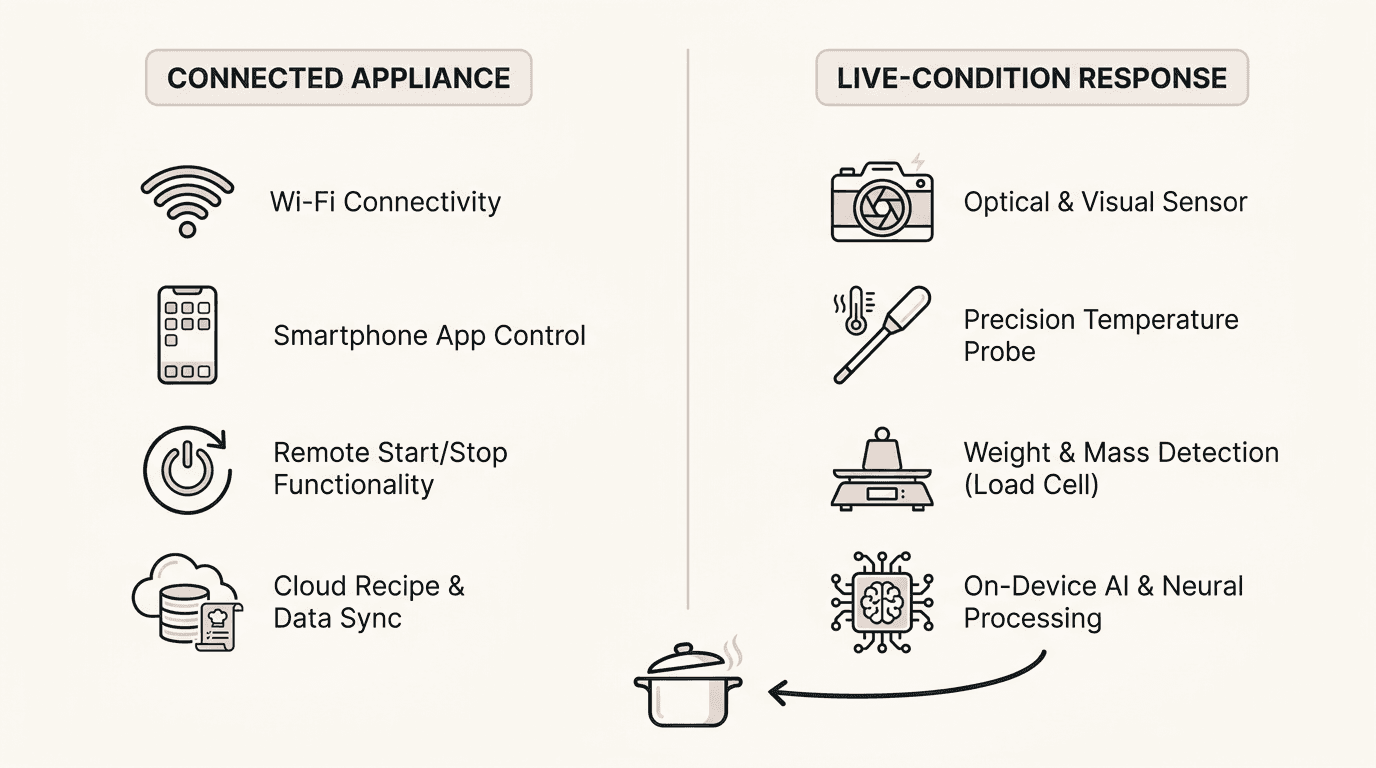
Not all smart appliances are equal - connectivity and live-condition sensing are fundamentally different capabilities.
The sections that follow focus on this sensor-led category: what different inputs can reveal, how they may work together, and what questions consumers should ask before treating an appliance as genuinely adaptive.
Computer Vision Cooking: What the Camera Actually Sees
A camera is one of the most visible components in an AI cooking system, but obtaining a usable image is only the first challenge. Steam, splatter, reflections, occlusion, changing illumination, and movement can all affect what a camera captures.
Research on food type and cooking-state recognition continues to identify real-world image quality, food variability, and occlusion as important limitations. Appliance makers therefore need to explain not only that a camera is present, but also what the complete vision system has been designed and tested to recognize.
A camera supplies images, but a trained model is needed to interpret what those images may represent. Cooking-state recognition is particularly difficult because food changes continuously and different stages can look similar. Research into continuous food-state recognition for cooking robots illustrates why training data and time-series observation matter. As one commercial example, Posha says its Culinary AI contains five million data points tracking changes in color, size, texture, and structure across thousands of cooking sessions. The dataset figure is a first-party Posha claim and should remain clearly attributed to the company.
Interpreting Visual Signals
What might a trained cooking-vision system observe? Depending on its model and training data, relevant signals can include changes in color, apparent size, texture, structure, bubbling, visible liquid, and the position or distribution of ingredients. Posha provides one commercial example: its Culinary AI overview describes recognizing active boiling, the disappearance of free water, clumped meat separating, and rigid noodles softening into cooking liquid.
Color is one of the most accessible visual indicators of cooking progress. Studies using machine vision to assess food color and cooking condition have shown that image analysis can help distinguish undercooked, cooked, and overcooked states under controlled conditions. Other potential indicators include changes in shape, surface appearance, bubbling, liquid level, and ingredient movement. Whether an appliance can act reliably on any one of these signals depends on the specific food, camera view, training data, and control system.
Info: Structural changes can be more difficult to interpret than a simple color transition because a two-dimensional image may not reveal depth, internal temperature, tenderness, or resistance. A system that claims to recognize a complex event such as meat separation should therefore explain the conditions under which that capability has been trained and tested.
Identifying Ingredients and Prep State
Computer vision can also be used to distinguish ingredients and preparation states before or during cooking. A diced carrot, a thick slice, and a purée present different visual features and may require different cooking treatment. Posha's Culinary AI material, for example, shows the system distinguishing preparation styles and ingredient sizes. That does not mean every vision-equipped appliance can automatically compensate for an unexpected cut size. Look for explicit manufacturer documentation before assuming the system can make that adjustment.
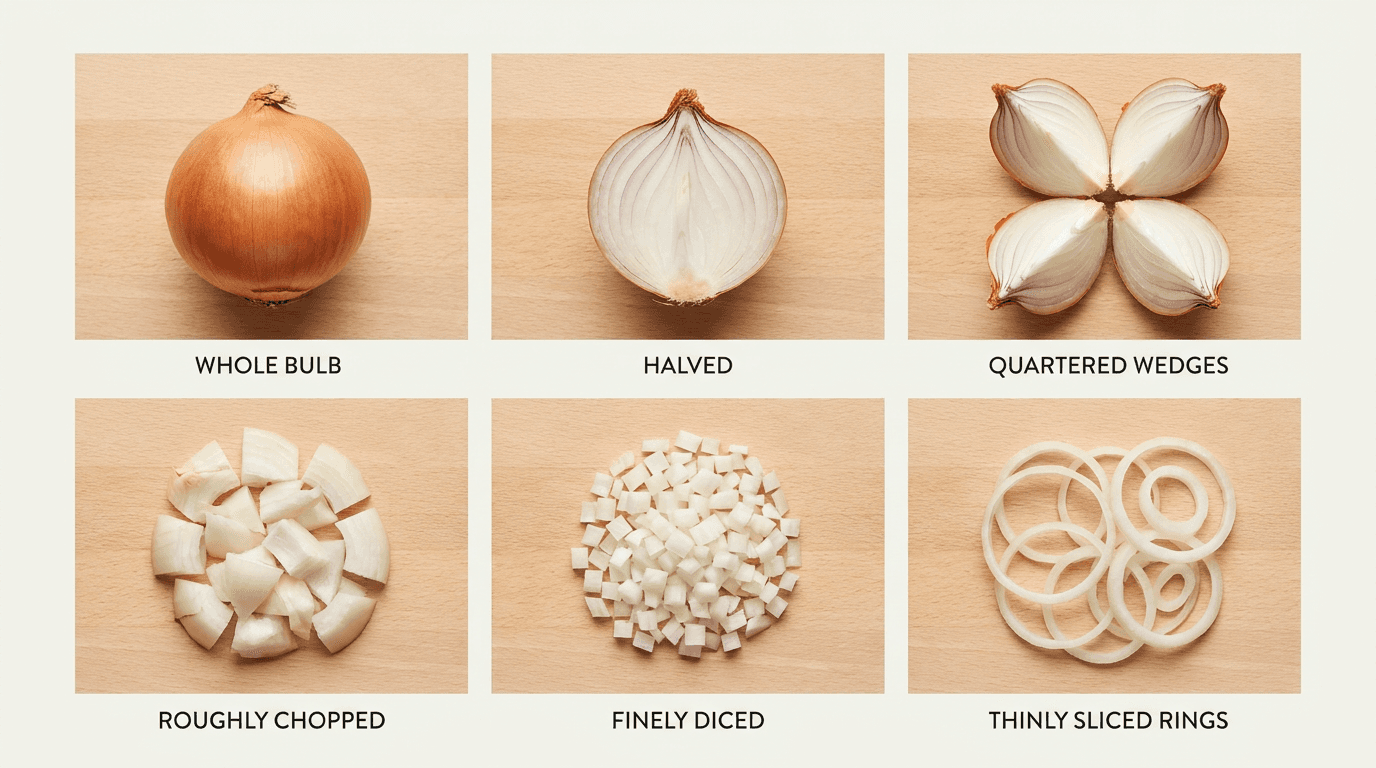
A vision model reads prep state from visual structure - something no timer or temperature probe can do.
Beyond the Camera: The Unseen Sensors of Kitchen Technology
Cameras cannot directly measure every condition that matters during cooking. Some systems therefore combine visual information with other inputs, such as temperature or weight. Research using combined color and thermal imaging for food analysis illustrates the broader value of complementary sensor types: each modality can contribute information that the other does not capture as directly.
Temperature sensors provide information that a standard visible-light camera cannot measure directly. They may monitor the appliance, cooking surface, vessel, or food, depending on the product design.
Temperature is particularly important for food safety because appearance alone cannot confirm that meat, poultry, seafood, or egg dishes have reached a safe internal temperature. The USDA therefore recommends using food thermometers to verify safe cooking temperatures rather than relying only on visible signs of doneness.
Some kitchen-appliance designs incorporate weighing sensors or load cells to measure ingredients or changes in mass during cooking. For example, a published kitchen-appliance weighing-sensor design describes using weight measurements to estimate water evaporation during rice cooking. This shows what weighing technology can potentially contribute, but it should not be presented as a standard component in all AI cooking appliances.
Motor load can also provide indirect information in equipment that mixes or stirs food. As viscosity and resistance change, the effort required from the motor can change as well. Research into motor-current sensing for automated food mixing has examined how electrical current can be used to estimate load variation during agitation. That principle is relevant to food-processing automation, although a consumer appliance should not be assumed to use it unless the specification says so.
The Brains of the Operation: Where Does the AI Happen?
Sensors only matter if something can make sense of them quickly enough to act. That "where does the thinking happen" question, on the device or in the cloud, is one of the biggest design choices in modern cooking tech. It's also the one product pages tend to blur into a vague "smart" badge.
Cloud-Based vs. On-Device AI Processing
Cloud processing sends some data or computed features to remote infrastructure for analysis. It can provide access to substantial computing resources and centralized model updates, but its operation may depend on connectivity, network performance, and the manufacturer's data-handling practices.
On-device or edge processing performs some or all analysis near the source of the data. According to the National Institute of Standards and Technology's discussion of AI and processing at the edge, edge systems can support faster local responses and reduce the need to send every input to a centralized service. However, performance, offline availability, privacy, cost, and model capability depend on the implementation. Consumers should check the product's technical documentation and privacy policy instead of relying on an "edge AI" label alone.
For time-sensitive control, the complete response loop matters: sensor capture, model processing, decision-making, and the appliance's physical reaction. Local processing can reduce dependence on a network round trip, but the presence or absence of an NPU does not by itself establish how capable the system is.
AI models can run on CPUs, GPUs, dedicated accelerators, or combinations of hardware. A useful specification should explain what the appliance detects, which actions it controls, which functions require internet access, and how quickly the system can respond under normal operating conditions.
Processing and privacy claims should be stated only as precisely as the manufacturer's current documentation allows. Posha's Culinary AI page explains what its vision system is designed to recognize, while the company's Privacy Policy states that the built-in camera is active only during cooking and that it captures images for real-time cooking assistance and handles those images according to its current privacy practices.
Readers should refer to Posha's Privacy Policy for details about how camera data is processed, stored, or transmitted. Posha's public documentation does not currently state that all vision inference happens on-device, so that should not be assumed.
Putting It All Together: How to Read a Spec Sheet in 2026
The next time you review a product page, use the following questions to distinguish a connected feature, a preset program, and a system that responds to live cooking conditions.
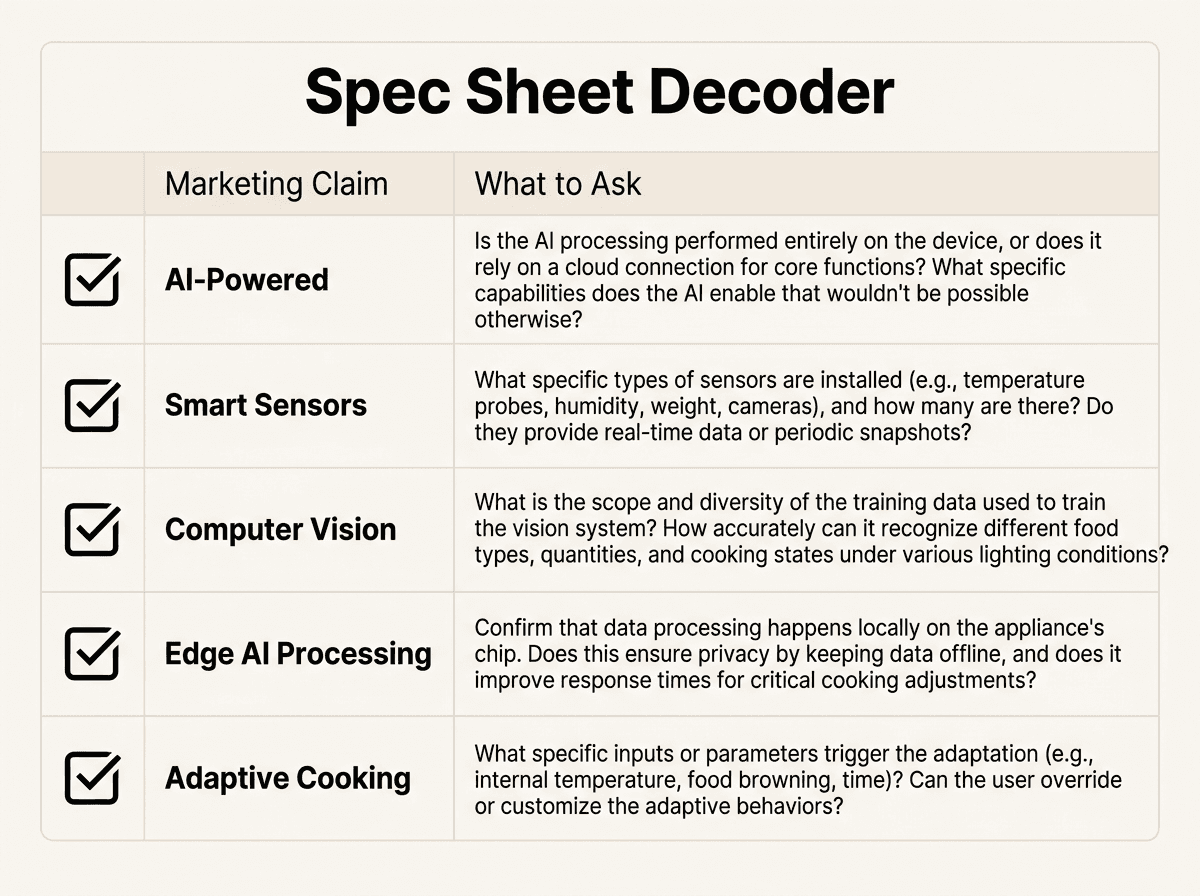
Five marketing phrases and the technical questions that reveal what is actually inside the machine.
When a product says "AI-powered," ask what the AI actually does. Does it recommend recipes, recognize an ingredient, estimate a cooking stage, adjust a controlled function, or perform several of these tasks? Also check which features require an internet connection and whether the manufacturer documents where relevant data is processed.
When a product says "smart sensors," ask which measurements are being taken. A temperature probe, camera, weighing system, and motor-feedback signal provide different information. More sensors do not automatically make a better product; what matters is whether the inputs are relevant, accurate, and connected to useful cooking actions.
When a product says "computer vision," ask what the model has been trained and tested to recognize. Ingredient identification, preparation-state recognition, cooking-stage estimation, barcode scanning, and remote viewing are separate capabilities.
When a product says "adaptive cooking," ask what causes the adaptation. A system may adapt recommendations based on previous choices, or it may alter heat, timing, or stirring in response to current sensor readings. Both can be useful, but they solve different problems.
When a product emphasizes the size of its recipe library, evaluate that separately from its sensing and control capabilities. Recipe variety determines what users can choose to make; sensing and control determine what the appliance can monitor and change while a supported recipe is running.
Tip: Recipe count and adaptive capability should be evaluated separately. A large library provides choice, while sensing and control determine how an appliance manages a supported recipe once cooking begins. Neither number alone establishes overall product quality. Consumers should also consider preparation requirements, usable capacity, supported cooking techniques, maintenance, privacy, and how much intervention remains necessary.
The value of modern cooking technology ultimately depends on how it fits into a household's routine. The guide to healthy home-cooked meals for busy families considers hands-on preparation, fresh ingredients, and weeknight constraints.
For households comparing different ways to reduce active cooking time, the review of meal delivery services versus automated home cooking outlines the practical trade-offs.
The Difference Between Telling Time and Knowing When the Garlic Is About to Turn
The most meaningful distinction in modern cooking technology is not whether an appliance has an app or uses the word "AI." It is what the system can observe, what it can control, and whether those capabilities make a measurable difference during a supported cooking task.
A camera, temperature sensor, weighing system, motor signal, or AI processor is not meaningful in isolation. The important question is how accurately the complete system interprets its inputs and whether it can translate them into useful actions such as changing heat, adjusting timing, stirring, or notifying the user. Products should be compared by documented behavior rather than by the number of technical terms on the specification sheet.
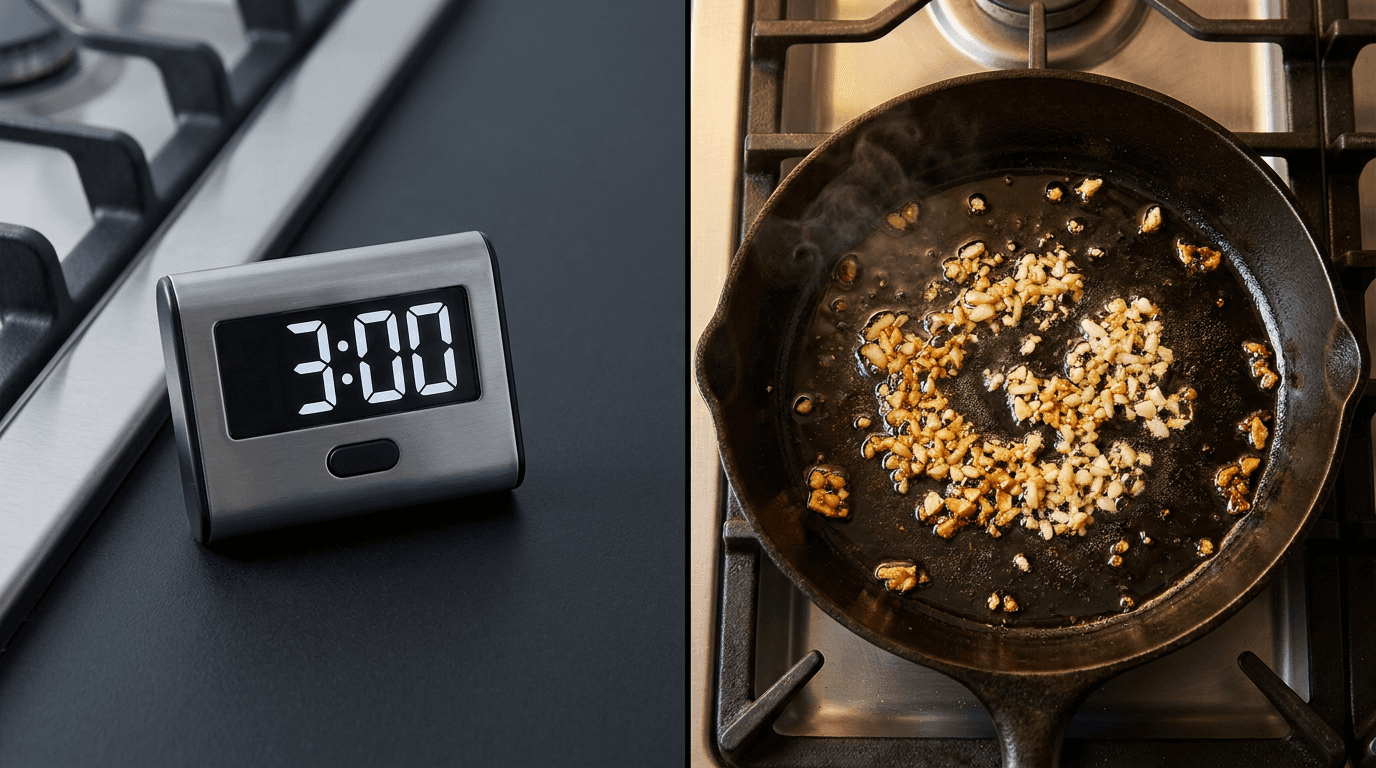
Time-based cooking and observation-based cooking are fundamentally different technologies - one counts seconds, the other reads the pan.
If you want the full technical breakdown of Posha's sensing stack, start at HOW POSHA THINKS. If you want to see what that hardware turns into on an actual plate, EXPLORE POSHA +
The machine that can tell when the garlic is about to turn is a different machine from the one that can tell the time.
Frequently Asked Questions
Does an AI cooking appliance need an internet connection?
It depends on the product and the feature. Some appliances use the internet for recipe downloads, account services, remote control, software updates, or cloud-based analysis. Others may perform selected functions locally. Check which cooking features remain available offline rather than assuming that an "edge AI" label (or the presence of a particular processor) means the entire appliance works without a connection.
Can cooking computer vision work in low light?
It can, but performance depends on the complete imaging design. Camera placement, built-in illumination, reflections, steam, splatter, contrast, and occlusion can all affect image quality. Consumers should look for documented operating conditions or demonstrations rather than assuming that every camera-equipped appliance performs equally well in a dark or visually obstructed cooking environment.
How is this different from the sensors in a conventional smart oven?
The answer depends on the model. Some connected ovens use temperature probes, preset programs, notifications, or cameras intended primarily for remote viewing. A more adaptive system may analyze sensor readings or images and use that interpretation to alter a cooking setting. Check whether the product merely displays information to the user or whether it can automatically act on that information during cooking.
What is a neural processing unit, and why might it matter in kitchen technology?
A neural processing unit, or NPU, is specialized hardware designed to perform certain machine-learning calculations efficiently. It can support local AI processing, but it is not the only hardware capable of running an AI model. CPUs, GPUs, systems-on-chip, and other accelerators may also be used. An NPU in a specification is therefore one technical detail, not proof by itself that the appliance is adaptive, fully local, fast, or able to work offline.
Will this technology replace the need to know how to cook?
It can change which parts of cooking require active attention, but it does not eliminate every user decision. The level of involvement varies by product: users may still choose the dish, buy and prepare ingredients, load the appliance, adjust preferences, and follow cleaning and safety instructions.