Rohin Malhotra
Labor Day is one of the year's better appliance-buying windows, with major retailers offering discounts on big-ticket appliances around the holiday weekend (Consumer Reports, 2026). That can mean real value. It also produces plenty of handsome boxes that are gathering dust by February. Smart kitchen appliances are particularly vulnerable to that fate.
Skip the sale roundup and pressure-test the appliance instead. These nine checks reveal whether a device will change dinner on an ordinary weeknight or merely add another screen to the kitchen.
The Nine-Point Countertop Test: Your Smart Kitchen Appliance Buying Guide
Specs are not the point. Match the appliance against Tuesday's dinner, your actual counter space, and the chores that keep returning. Miss one of those details and a seemingly good purchase can become an expensive inconvenience.
1. The Recurring Problem It Solves (and How Often You Have It)
Name the job you want removed. Not "I want to cook more," but "I abandon dinner at 6:30 because I cannot watch the stove and help with homework." Automation earns counter space when it solves a problem three or four times a week. "Weekends only" rarely justifies a premium price. Write the problem down before browsing.
2. The Spectrum of Smart: From Remote Control to Autonomous Cooking
"Smart" now covers an enormous range, from Wi-Fi-connected appliances that allow remote control to more advanced systems that use sensors, cameras, or AI to respond to food as it cooks. Those are not remotely the same product. The four levels below make the difference plain.
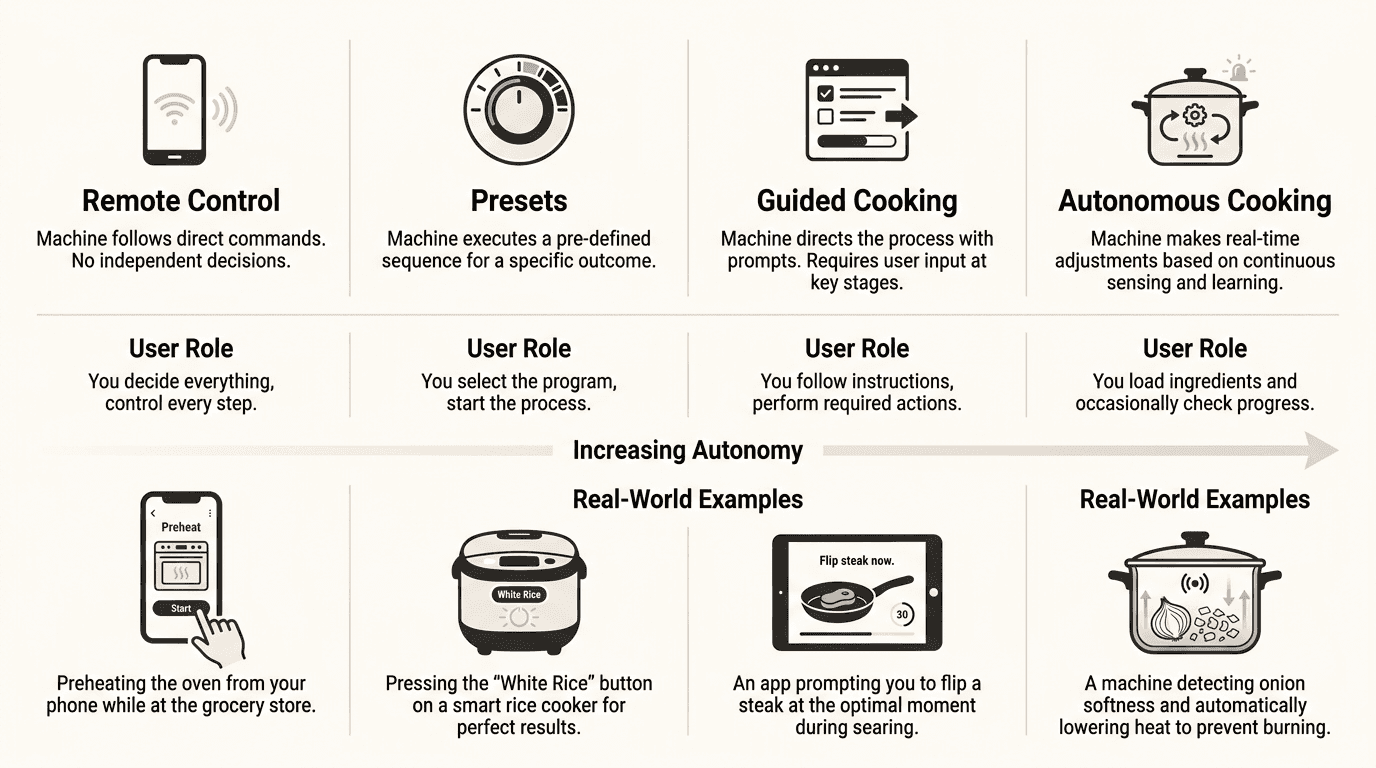
The further right on this spectrum, the less the cook has to monitor or intervene.
The four levels at a glance:
Remote Control: Takes commands from your phone. You still make every decision, just from farther away. Example: preheating an oven from the couch.
Presets: Runs fixed time-and-temperature programs. You choose a preset, and the machine follows it blindly. Example: a rice cooker with a "white rice" button.
Guided Cooking: Prompts you through each step. You still do the work when prompted. Example: an app telling you when to flip chicken.
Autonomous or Adaptive Cooking: Detects conditions and changes heat, timing, or technique mid-cook. You load the ingredients and check the result. Example: a machine that sees onions browning and lowers the heat before they burn.
Many shoppers expect level four and bring home level two. For more on the technology behind that gap, see how AI, cameras, and sensors are changing cooking. For category comparisons, countertop cooking robot vs. multicooker vs. smart oven is a useful starting point.
3. What the Machine Actually Sees, Feels, and Does Mid-Cook
Sensors are where the intelligence either exists or does not. A probe can register a roast at 165°F; a scale can track changes in weight during cooking, which may reflect evaporation in some cooking setups; a camera using computer vision can spot translucent onions or a bubbling sauce. Ask what the device measures and what it changes in response. If nothing changes mid-cook, it is a preset machine, whatever the packaging says.
Posha shows what the adaptive end of 'smart' cooking looks like: its built-in camera watches cooking progress, while the system adds ingredients, adjusts heat, and stirs as the dish develops. Instead of simply executing a fixed timer, it can observe what is happening and respond during the cook. For any appliance marketed as autonomous, check which cooking actions it can perform without intervention and which steps still require the cook.
4. The After-Dinner Reality: Cleanup
Warning: What most people miss about cleanup: a store demo is not turmeric curry or a reduced sauce stuck to the pan. Ask how it cleans after those meals. That is the test.
Cleanup decides long-term use more often than buyers expect. Check which parts detach and whether the manufacturer explicitly lists them as dishwasher-safe, a softer claim often buried in fine print. Also inspect the main unit. How are the camera lens, heating element, and non-submersible stirring mechanism cleaned?
With Posha, the pan, ingredient containers, spice pods, stirrer, and cooking attachments are designed to detach for cleanup, with several components listed as dishwasher-safe. That is the kind of detail worth checking before any smart appliance earns permanent counter space.
5. Usable Capacity and Footprint
Capacity claims are usually generous. A six-quart vessel may stir-fry only two good servings before it steams rather than sears. Measure the counter and cabinet clearance. An appliance that cannot live under the cabinets ends up in a closet, and then stops being useful. Ask how many recurring cooking jobs the appliance can actually take over. A system that can handle multi-step stovetop dishes, stirring, simmering, sautéing, and ingredient timing earns its footprint more easily than a single-purpose gadget. Modern kitchen appliances worth the counter space offer a practical way to make that calculation.
6. Does It Actually Cook for You Specifically?
Personalization is more than saved favorites. It is accounting for dietary and allergen preferences, reducing chili heat for a child, flagging tree nuts, or suggesting a substitute. For households with dietary restrictions, that determines whether the machine is usable. Posha's companion app offers spice-level adjustments, diet and allergen settings, and ingredient swaps across its recipe library. That is part of cooking, not a decorative filter.
7. Subscriptions, Ecosystems, and Total Ownership Cost
The sticker price is seldom the final price. Recipe and feature subscriptions are common; what matters is what remains after cancellation. New members are eligible for a 90-day free trial, and owners who do not subscribe can still use Co-Pilot mode and the free Essential recipes collection. Verify current terms on the Posha Circle membership page before buying, since pricing can change.
8. Recipe Access and the Cuisine Fit
A thousand recipes mean little if none resemble dinner at your house. Check regular cuisines and staples before committing. Posha's smart recipes page lists 1,000-plus recipes across cuisines and diets. Compare that catalog with your meal rotation.
9. Privacy, Security, and Software Longevity
According to the University of Bradford (2025), internet-connected home devices, including smart kitchen appliances, can be vulnerable when passwords, software updates, and built-in security are poorly managed. There is also a broader longevity question with connected appliances: if important features depend on cloud services, buyers should understand what would still work if online support or software services changed in the future. Ask what works locally if servers go offline, and how the manufacturer handles cooking data, camera footage, and updates. A device that becomes a dumb pot after a company pivots is not the same purchase as one with solid offline capability.
The Final Verdict: Will You Still Love It in February?
After all nine checks, the question is simple: does it remove a recurring burden, suit the meals you make, and prove its intelligence on the plate? Not on a touchscreen or in an app. On a Wednesday night with 30 minutes and no patience.
The smart kitchen appliances worth keeping are the ones that understand what is happening in the food and take over the cooking work that normally keeps you tied to the stove. That is where systems like Posha stand apart from appliances that are 'smart' mainly because they have an app or a preset. For category context without the sales pitch, a practical guide to the smart kitchen covers the broader picture.
Tip: Decision rule: buy the appliance that removes a recurring cooking burden, fits the meals you make, and proves its intelligence in the food, not on the touchscreen.
Frequently Asked Questions
What's the difference between a smart oven and a smart multi-cooker?
A smart oven manages dry heat: roasting, baking, and broiling, sometimes with sensors. A smart multi-cooker handles braising, steaming, and slow cooking; some models may add features such as automated stirring, depending on the appliance. Choose based on where the recurring work happens: oven or stovetop.
Do I need a special subscription for all smart kitchen appliances?
No, but many devices charge for premium recipes, personalization, or features. Check what works without the plan and after cancellation. Check exactly which cooking modes, recipes, and features remain available if the subscription ends.
What happens to my cooking data?
Security can vary across smart kitchen appliances. Before buying, review the manufacturer's privacy terms, check how often the device receives software updates, prefer local processing where available, and change any default passwords during setup.
Can a smart appliance really replace my stove or oven?
For certain tasks, yes. An autonomous appliance can take over sautéing, simmering, and sauce-building. It cannot replace a full range for high-heat searing, large-batch baking, or several dishes at once. Consider it a partial replacement.
How much time do smart kitchen appliances actually save?
It depends on the automation. Remote control saves little active time. A machine that stirs, adjusts heat, and manages ingredient timing can reduce the amount of active attention a meal requires, especially for dishes that normally need regular stovetop monitoring.