Rohin Malhotra
Ganesh Chaturthi 2026 begins Monday, September 14th. Installation, the first naivedyam, and the festival's most important prasad all arrive on a workday. For families raised with Ganpati at home, the food is not an optional extra. It is the offering. And ukadiche modak, with its filling and delicate rice-flour shell, does not reward rushing.
The answer is not taking a day off, nor is it reducing the menu to something unrecognizable. Put the demanding dishes on the preceding weekend, make components that hold well, and keep weekday prasad modest and proper. Here is the schedule.
What Ganpati festival food actually means
Prasad is food made in devotion, offered before it is shared. Calling modak a "festival snack" misses why the dish is there: coconut and jaggery cooked down, pleats formed one by one, steam rising from the plate before Ganesha. None of that is decorative. It is ritual.
The ten-day arc of Ganesh Chaturthi has its own rhythm. Day 1 is sthapana, when the murti arrives and receives its first naivedyam. Fresh offerings follow each day; Day 10 brings visarjan and a farewell meal with a different kind of weight. Some dishes belong to particular moments because tradition put them there, not because they are convenient.
This menu rests on four Maharashtrian standards: steamed ukadiche modak, puran poli, karanji, and fried talniche modak. Steamed and fried modak are not substitutes. The rice-flour ukadiche modak is the traditional naivedyam and the offering Lord Ganesha is said to prefer. Fried modak, usually made with wheat flour or maida, is a much-loved sweet with a different ritual role.
Note: Diaspora families can feel obliged to make the entire ten-day repertoire on Day 1. Don't. The festival lasts ten days because devotion is meant to continue, not be crammed into one exhausted afternoon. Make less, and make it attentively.
The working-week menu: what to make, when to make it
The plan borrows the useful part of a weekly meal prep strategy: do the long work early, batch what travels, and leave lighter cooking for later. Here, that structure protects the offering from becoming another late-night task.
Five dishes carry the week: ukadiche modak and puran poli from the weekend; fried modak made with saved filling; panchamrit, which needs no heat; and quick sabudana khichdi.
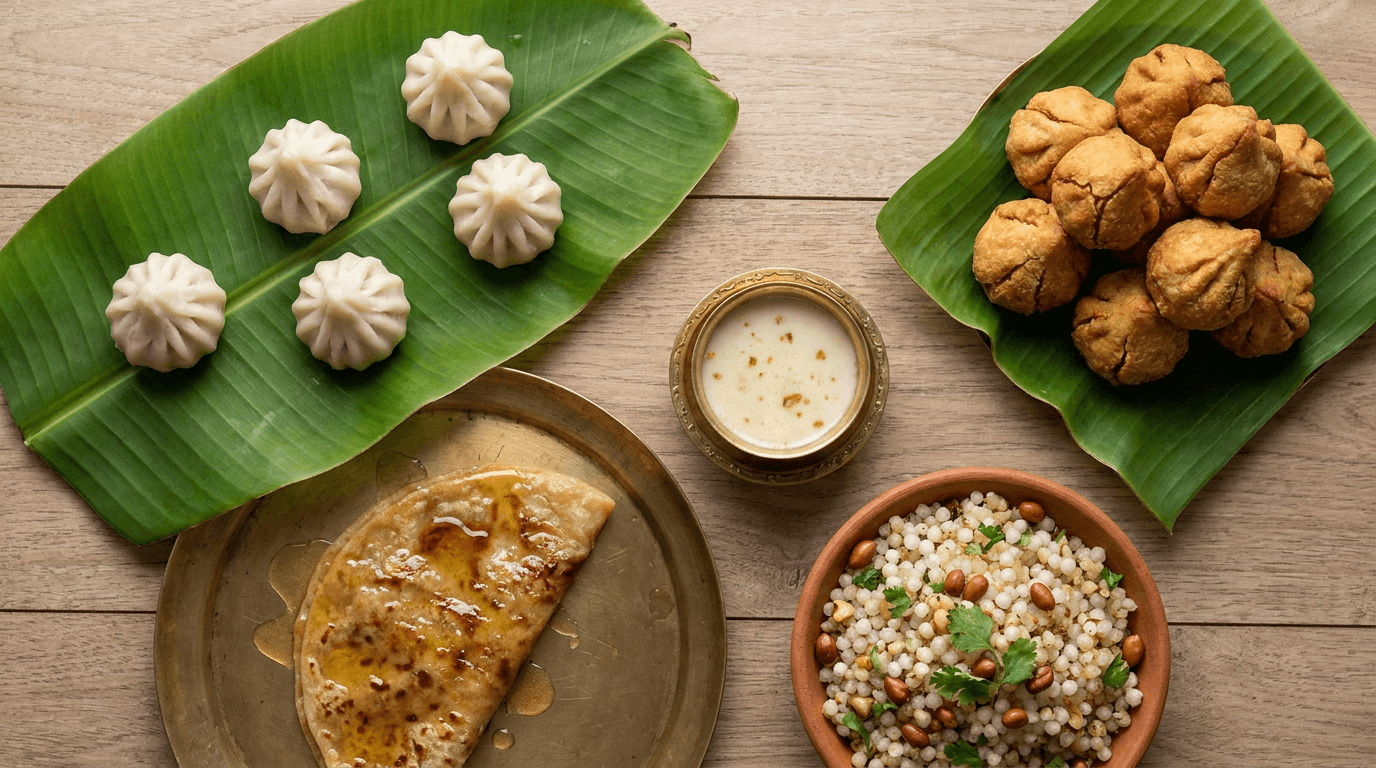
Weekend anchor: ukadiche modak
Ukadiche modak is the one dish many families will not leave out. It is Lord Ganesha's preferred offering: a steamed rice-flour dumpling around coconut, jaggery, cardamom, and nutmeg. Start with the filling. If it is too wet, it will split the shell in the steamer.
Steaming is the unforgiving part: 10 to 12 minutes over medium heat on a greased plate. Underdo it and the pleats remain raw; overdo it, and the modak turns sticky and slack. A batch of 11 or 21, both auspicious counts, takes about 90 minutes in total, with roughly 45 to 50 minutes of active prep. Saturday morning is a sensible slot for a practice batch or advance prep.
Weekend anchor: puran poli
Puran poli is another pillar of Maharashtrian Ganpati cooking: a thin ghee-brushed flatbread wrapped around sweet chana dal and jaggery. Make the puran a day ahead and refrigerate it; rolling fresh dough later makes this a credible weekday dish.
Do not hurry the dal or stop the jaggery mixture too soon. Wet puran breaks through the dough and turns the tawa into a sticky cleanup job. Cook until the filling gathers into one mass and pulls cleanly from the pan.
Weeknight prasad recipes that don't require a production
These three options are realistic after a workday.
Fried modak (talniche modak) uses the coconut-jaggery filling from ukadiche modak. Save extra filling on Saturday, then make a wheat-flour dough, fill, shape, and fry on a weeknight - about 30 minutes. The dough is kinder than rice flour, and frying moves faster than steaming. Modak appears across India in many forms; this coconut-jaggery version is Maharashtrian.
Panchamrit is simply milk, yogurt, honey, sugar, and ghee mixed and offered. Sabudana khichdi needs an overnight soak, then 15 minutes in the pan. It is fast, fitting for the festival, and substantial enough for a light supper.
Tip: Simple prasad is not lesser prasad. Panchamrit has been offered for centuries; it is not a fallback.
The modak recipe in full: steamed vs. fried, side by side
The filling overlaps. The dough, heat, and tolerance for error do not.
Steamed (ukadiche) | Fried (talniche) | |
|---|---|---|
Active prep time | 45-50 min | 25-30 min |
Total time (1 batch) | About 90 min | About 45 min |
Equipment required | Steamer, heavy-bottomed pan | Kadhai or deep frying pan |
Dough base | Rice flour, scalded with boiling water | Wheat flour or maida |
Difficulty level | High: dough and steaming are unforgiving | Moderate: oil temperature matters most |
Shelf life | Best the same day; refrigerate up to 24 hrs | 2-3 days in an airtight container |
Appropriate as naivedyam prasad | Yes; the traditional first offering | Yes, but not a Day 1 replacement for ukadiche |
Steamed modak (ukadiche modak): the full process
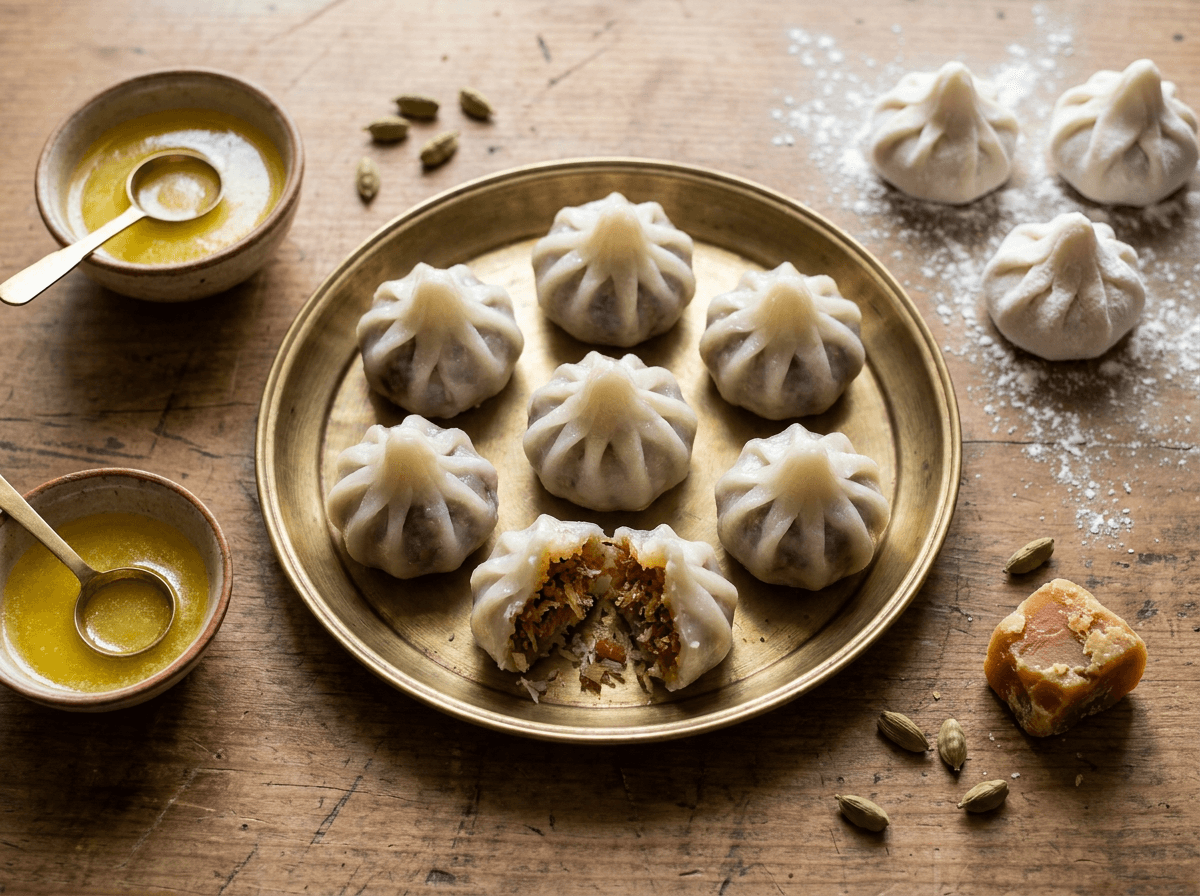
Filling first. Grate fresh coconut; frozen is fine if you squeeze out excess water. Briefly dry-roast it in a heavy pan, add crumbled jaggery, and stir over medium-low heat until the mixture pulls from the pan and holds when pressed. That texture matters more than a timer. Stir in crushed cardamom and a pinch of nutmeg off heat, then cool.
Dough. Bring water, salt, and a teaspoon of oil to a rolling boil. Tip in the rice flour at once, stir quickly, cover for two minutes, then knead with oiled hands while it is hot. Lukewarm water will leave you with dough that cracks as soon as shaping begins.
Shaping. Flatten a small ball into a cup, add a teaspoon of filling, then close the pleated edges. Thirteen pleats is traditional; a modak mold is also perfectly valid and makes a sturdy shell. Steaming. Space the modak on a greased plate and steam 10 to 12 minutes over medium heat. At 10 minutes, the shell should be faintly translucent and release cleanly.
Fried modak (talniche modak): the more forgiving weeknight version
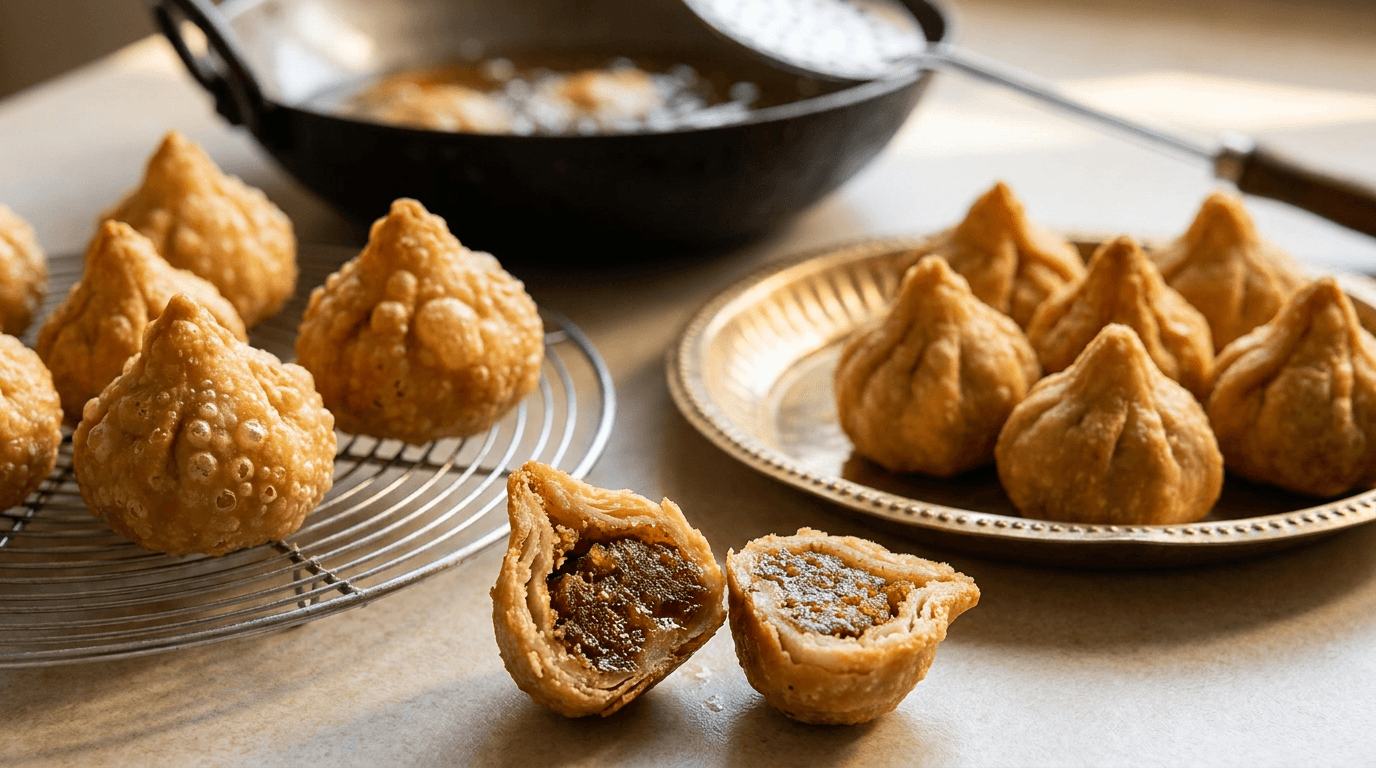
This dough uses wheat flour or maida, not rice flour: elastic to roll but vulnerable in hot oil. Temperature decides the result. Cool oil makes a greasy shell; hot oil browns it before the inside is warmed. Hold it near 170C (340F), frying small batches.
There are regional versions. Bengal's uses khoya; Tamil Nadu's often brings in sesame and rice flour. This follows the Maharashtrian talniche modak, with a coconut-jaggery center and crisp wheat shell.
Where most home cooks lose the plot
Most modak trouble comes down to three things: a wet filling, cracked dough, or too much steam. Knowing the cause is more useful than merely recognizing the wreckage.
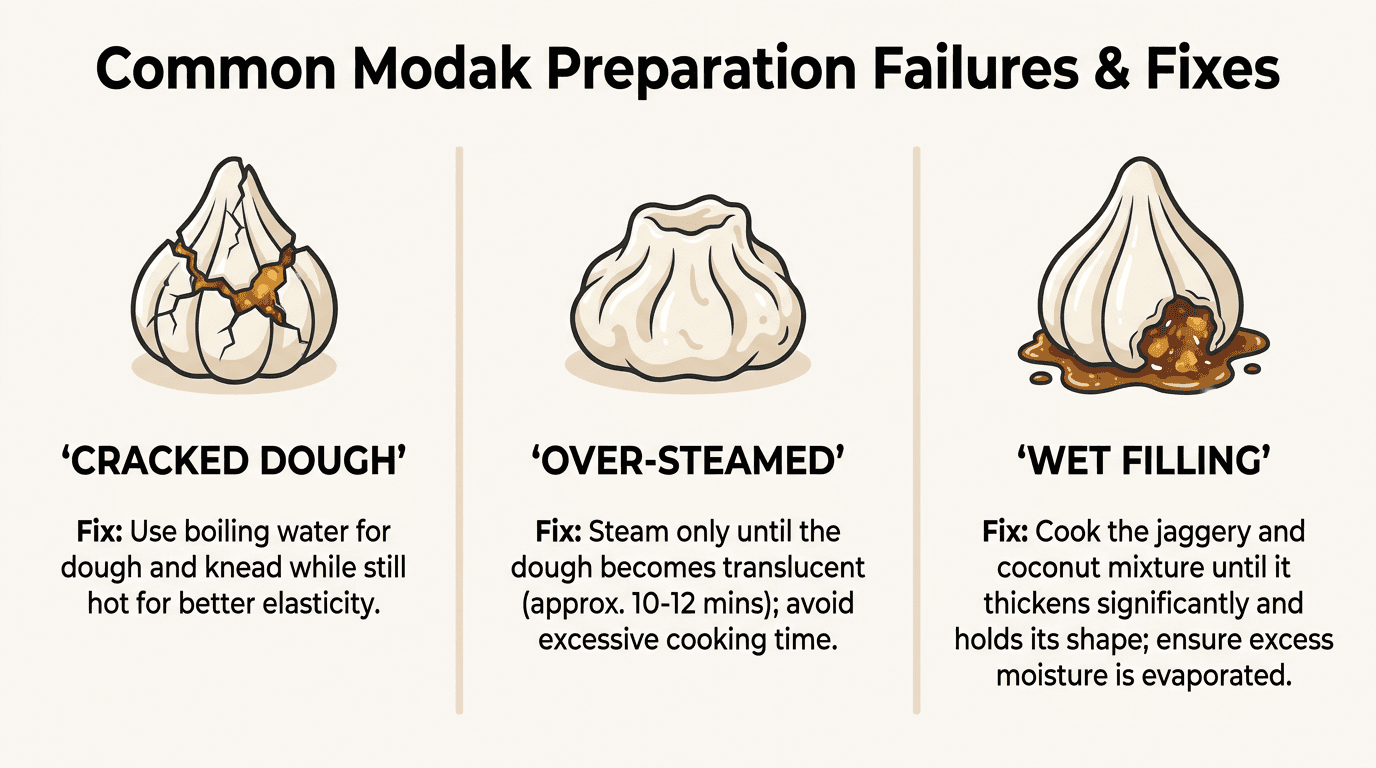
Wet filling means the jaggery has not reduced enough, or the coconut went in wet. Jaggery varies wildly: one dark, moist block behaves nothing like a dry, pale one. Cook by texture, not minutes. The finished filling should roll into a ball between your fingers.
Cracked dough nearly always points to water that was not hot enough. Rice flour needs fully boiling water for its starch to gelatinize. Knead while hot, with oiled hands, and keep the dough covered so it does not dry out.
Over-steaming leaves a gummy, shapeless modak. Set a timer and inspect at 10 minutes; a translucent shell that does not stick is ready. First batch on Chaturthi morning? Make a practice round the previous weekend. The filling freezes well, and a little rehearsal saves a lot of coconut.
How Posha fits into a festival kitchen
Festival cooking is rarely just one recipe. While one dish needs stirring, another needs shaping, the steamer needs checking, and the rest of the kitchen is moving around the puja. That is where Posha can take over part of the cooking while you focus on the hands-on parts of the festival.
Posha uses its camera, temperature sensors, and Culinary AI to follow how food changes as it cooks. For supported recipes, it can manage steps such as ingredient timing, stirring, and heat adjustments without requiring you to stay beside the pan.
The handmade parts still stay handmade. Posha cannot replace the family judgment behind a good modak, the way you pleat it, or the filling ratio you grew up with. What it can do is manage supported cooking in the background while your attention stays on shaping modak, setting up the puja, or simply being with family.
The full week at a glance: a practical schedule
Ganesh Chaturthi 2026 falls on Monday, September 14th. Start the Saturday before and carry through the first three weekdays. Active cooking comes to roughly four to five hours, broken into manageable sessions.
Day-by-day breakdown:
Saturday (Sept 12): Make the coconut-jaggery filling for ukadiche modak and refrigerate it. Double the coconut-jaggery filling and refrigerate the extra. If this is your first attempt, make the test batch today.
Sunday (Sept 13): Cook and refrigerate puran for puran poli (40 min). Make the dough and roll a few polis for practice or Sunday dinner (30 min).
Monday (Sept 14, Chaturthi Day 1): Shape and steam fresh ukadiche modak using the prepared coconut-jaggery filling, or offer panchamrit (10 min, no cooking). Roll fresh puran poli from Sunday's filling (20 min).
Tuesday (Sept 15): Make fried modak with stored filling (30 min). Soak sabudana for Wednesday.
Wednesday (Sept 16): Cook sabudana khichdi (15 min). Offer it with any fried modak that remains.
Use the same pattern for the days that follow. Harvard's meal prep research makes the practical point: batching components such as filling and puran lowers the week's cognitive load without lowering quality. For more ways to fit Indian food into an ordinary evening, see this collection of weeknight Indian dinner strategies.
Frequently Asked Questions
Can I make ukadiche modak a day ahead, and how should I store it?
Ukadiche modak are best made fresh on the day they are offered. If you are preparing ahead for eating later, refrigerate them in one layer in a parchment-lined airtight container and re-steam for 3 to 4 minutes before serving. For the Day 1 naivedyam in this plan, prepare the filling ahead and shape and steam the modak fresh on Monday.
How do ukadiche and fried modak differ, and can one replace the other as prasad?
Ukadiche modak is steamed in a rice-flour shell and is the traditional Day 1 naivedyam for Lord Ganesha. Fried talniche modak uses wheat flour or maida. Both can be prasad, but they do not occupy the same ritual place. If only one is possible for installation day, most families prioritize ukadiche.
Why does my rice-flour dough crack while I shape modak?
The water was probably not at a full rolling boil when the flour went in. Rice starch will not gelatinize properly in cooler water, and every fold will split. Knead while the dough is hot, using oil on your hands, and cover it with a damp cloth as you work.
Which Maharashtrian festival recipes actually work after work?
Fried modak, when the filling is already made, takes about 30 minutes. Panchamrit requires no cooking, and overnight-soaked sabudana khichdi takes 15 minutes. Puran poli also works if the weekend covered the filling. Ukadiche modak is usually better saved for the weekend.
Can jaggery powder replace block jaggery in modak filling?
They behave differently. Block jaggery is wetter and melts more slowly, giving more control over reduction. Powder dissolves quickly and can leave filling too wet. If using it, cut the amount by about 15 to 20 percent and cook over lower heat. Experienced cooks generally prefer block jaggery for modak.