Rohin Malhotra
A flexitarian diet is mostly plant-based, with meat, fish, and other animal foods showing up when you actually want them. The name is literally "flexible" plus "vegetarian," and it sets the tone: you cook like a vegetarian most days, without signing up for strict rules.
If you and your partner usually cook vegetables, legumes, and grains, but still make a chicken stir-fry on Friday or salmon tacos on the weekend, congratulations: you're already doing it. A 2024 YouGov report found 13% of U.S. respondents identify as flexitarian, and that share is trending up. It's easy to see why. You get a lot of the health and environmental upside of plant-forward eating, while still saying yes to your mother-in-law's pot roast now and then.
What Flexitarian Actually Means
Dietitian Dawn Jackson Blatner helped popularize the term in her 2009 book, and the pitch has stayed refreshingly steady: lean on fruits, vegetables, legumes, and whole grains; reach for plant protein first; and let meat play a supporting role instead of starring in every meal. No calorie math. No blacklist of foods. No shame spiral if you eat a burger. Healthline's comprehensive flexitarian diet guide frames it as more lifestyle than "diet," which is part of why it tends to stick.
You'll also see flexitarian grouped with what researchers call a semi vegetarian diet. A 2025 review in Nutrients (via NIH's PMC) looked at how global dietary guidelines talk about eating fewer animal foods, and it found "flexitarian" and "semi-vegetarian" are often used interchangeably. When people say flexitarian, though, they usually mean a conscious plant-first approach, not just "we happen to eat less meat." If you're curious about other eating styles like the Paleo diet, the contrast is useful: Paleo cuts out grains and legumes, which are basically the backbone of everyday flexitarian cooking.
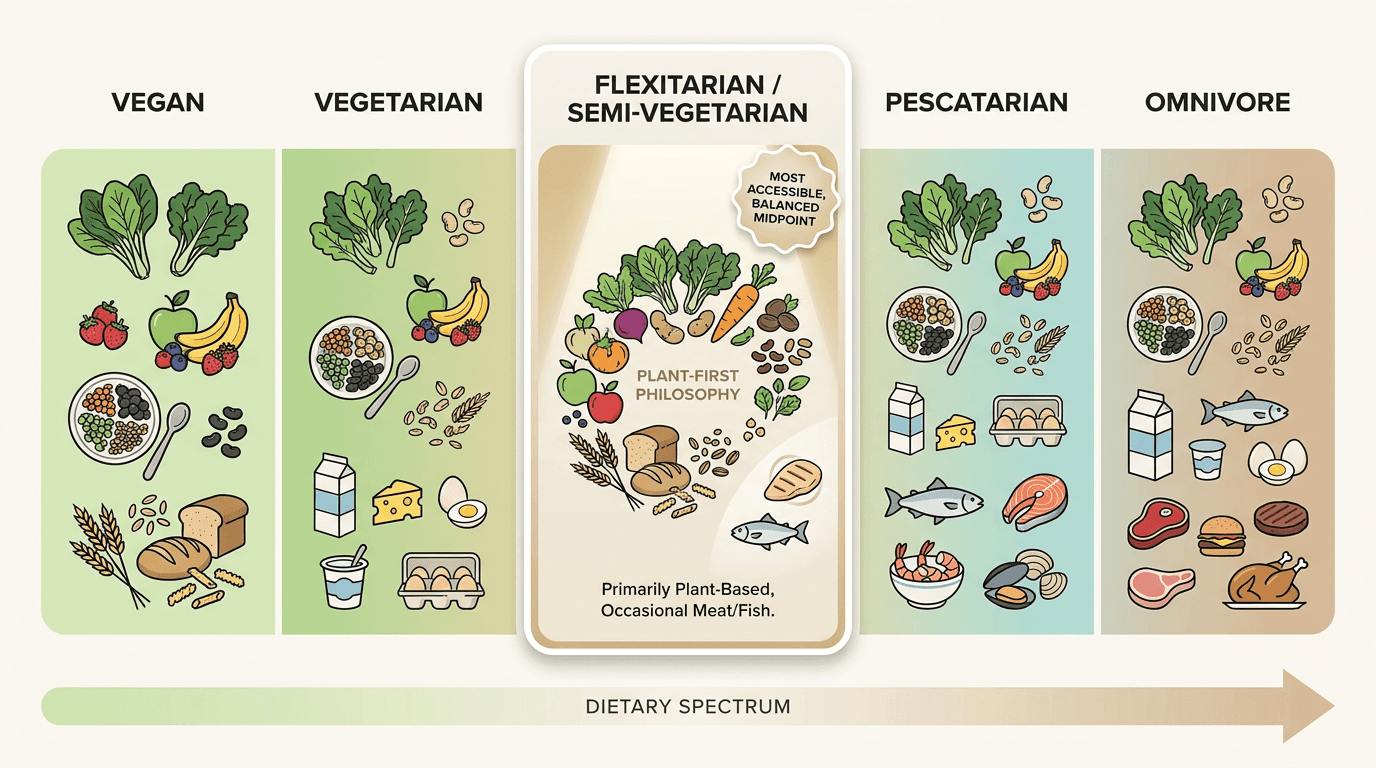
Flexitarian sits at the accessible midpoint between vegan and omnivore eating patterns.
Why It Matters for Your Health and the Planet
The Cleveland Clinic links a flexitarian diet with lower heart disease risk, a lower likelihood of developing type 2 diabetes, weight management benefits, and possible protection against certain cancers. That lines up with what we already know about plant-heavy eating patterns: when plants do most of the work on your plate, good things tend to follow. And having meat sometimes doesn't seem to erase those benefits.
Then there's the climate angle. Eating less meat generally means using fewer resources, producing fewer greenhouse gas emissions, and putting less pressure on land and water compared to a typical omnivore diet (Our World in Data, 2021). You don't have to go full vegan to matter here. Swapping meat for beans and grains three or four nights a week is the kind of change that adds up when enough people do it.
One real watch-out: if you cut back on meat but don't replace it thoughtfully, you can come up short on iron, zinc, vitamin B12, and omega-3 fatty acids. The Cleveland Clinic suggests being deliberate with plant-based proteins like paneer, legumes, nuts, seeds, and fortified foods. This isn't a reason to avoid flexitarian eating; it's just a nudge to make the "plant-forward" part sturdy enough to stand on its own.
Flexitarian Foods: What to Stock and What to Limit
Flexitarian foods at a glance
Category | Eat Freely | Eat Occasionally | Minimize |
|---|---|---|---|
Protein | Lentils, chickpeas, tofu, tempeh, edamame, eggs | Chicken, turkey, fish, shellfish | Processed meats, fast-food burgers |
Grains | Quinoa, oats, farro, brown rice, whole-wheat pasta | White rice, sourdough bread | Refined white bread, sugary cereals |
Vegetables | All vegetables, especially leafy greens | Starchy vegetables like potatoes | Fried or heavily sauced preparations |
Dairy & Alternatives | Greek yogurt, kefir, plant milks | Cheese, butter | Full-fat processed cheese products |
Fats | Avocado, olive oil, nuts, seeds | Coconut oil | Hydrogenated oils |
This list isn't meant to turn dinner into a moral ranking. BBC Good Food notes there are no strict rules on the flexitarian diet; you're aiming for a general shift toward more plants over time, not a perfect scorecard every night. And if your version of "flexible" leans heavily toward seafood, the pescatarian diet sits nearby on the same spectrum.
A Flexible Weekly Meal Plan
For couples, the friction point usually isn't "Where do we find flexitarian recipes?" It's the moment you realize you're about to cook two different dinners because one person wants meat and the other doesn't. The easiest workaround is to build a shared base that everyone eats, then finish each plate with the protein that fits. Here's a sample flexitarian meal plan built around that idea.
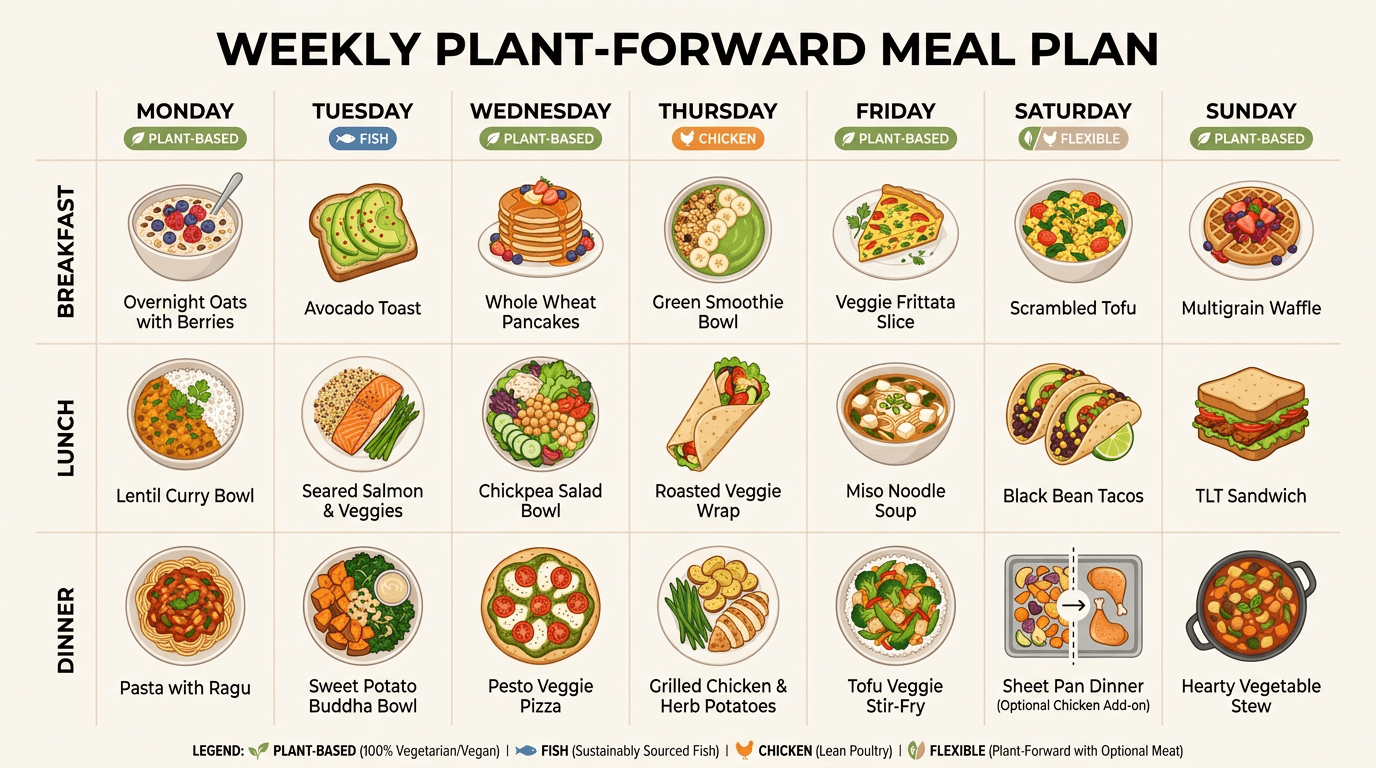
A sample flexitarian week: plant-based meals anchor every day, with fish and chicken as easy optional add-ons.
Sample 7-day flexitarian meal plan (dinner focus, since that is where the swap happens):
Monday (plant-based): Lentil and sweet potato curry over brown rice. Lentils carry the protein, with a dollop of Greek yogurt if you want it.
Tuesday (fish): Roasted cauliflower and farro as the shared base. One plate gets pan-seared salmon; the other gets crispy chickpeas. The timing difference is about 4 minutes.
Wednesday (plant-based): Black bean tacos with pickled red onion, avocado, and a chipotle-lime slaw.
Thursday (chicken): Bok choy, snap peas, and noodles in a ginger-sesame sauce for everyone. Add sliced chicken breast to one portion; add edamame and tofu to the other.
Friday (plant-based): Mushroom and spinach frittata with a simple green salad.
Saturday (meat, flexible): Sheet-pan dinner: roasted vegetables and white beans for everyone, with sausage links on one half of the pan for whoever wants them.
Sunday (plant-based): Pasta with a slow-cooked tomato and white bean ragu, finished with fresh basil and Parmesan.
The throughline is simple: make the plant-based version satisfying on its own, then treat meat or fish like the optional add-on. That keeps you out of the "two separate meals" trap. If you want more options that fit this structure, a rotating list of healthy dinner ideas makes weeknights feel a lot less repetitive.
Making Swaps Without Making Extra Work
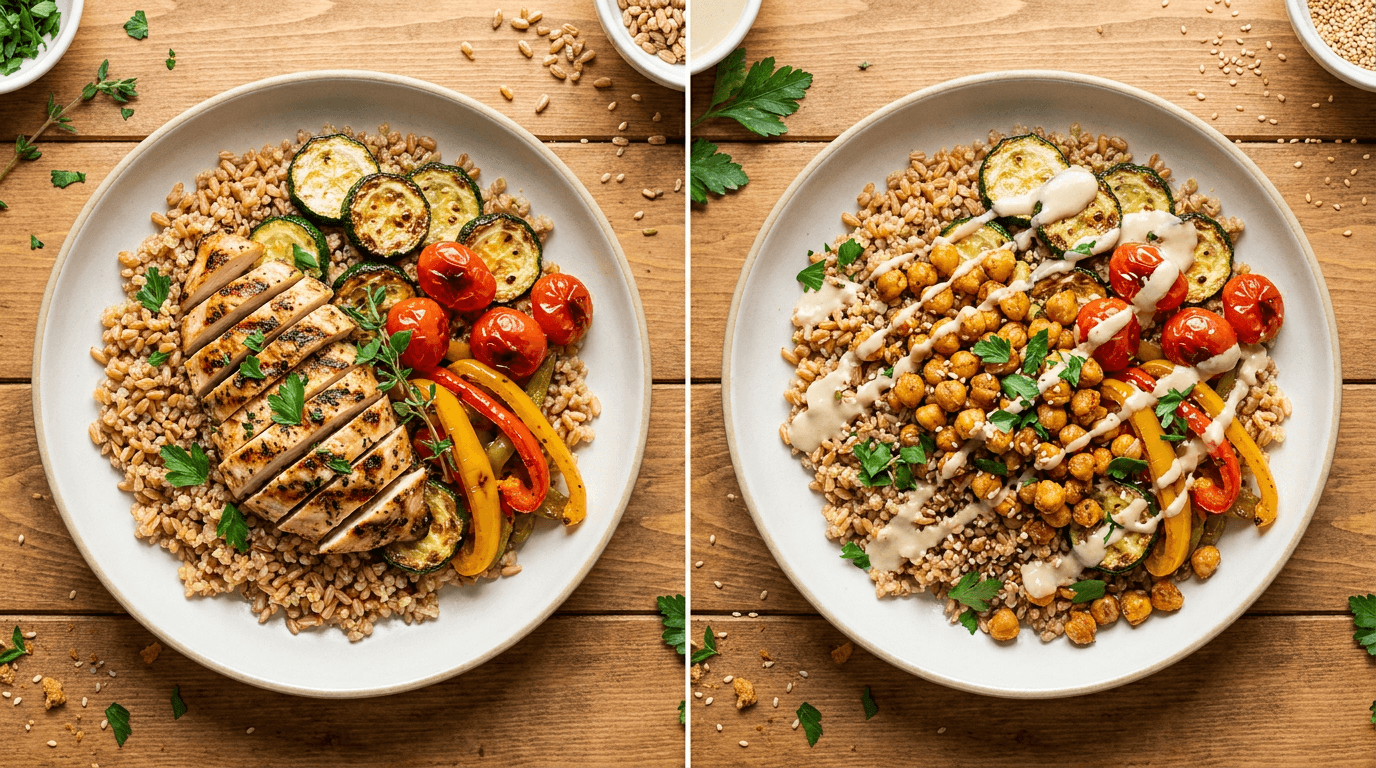
Same base, two proteins — the simplest way to cook flexitarian without doubling your effort.
The real flexitarian skill is swapping proteins without turning dinner into a logistics problem. Most plant proteins (canned beans, firm tofu, pre-marinated tempeh) need less hands-on time than raw meat, so order matters. A useful rule of thumb: if your shared base takes about 20 minutes, start chicken thighs early and add chickpeas in the last 8 minutes. Fish is the opposite: it usually goes in at the end and cooks in 5 to 6 minutes, while the plant protein can crisp up separately.
This is also where Posha's culinary AI fits neatly. Posha's Robot Chef cooks autonomously and adjusts timing when you swap proteins. Pick the base recipe, choose whether it's a chicken night or a tofu night, and it recalibrates so both portions land on the table together. That means fewer moving parts: no juggling two pans, no one eating while the other waits. When the goal is plant-forward eating you can actually keep up, that kind of coordination helps.
A little planning goes a long way here, too. Solid meal prep ideas look like batch-cooking one grain (farro, quinoa, brown rice) and one legume (lentils, black beans, chickpeas) on Sunday. With those in the fridge, you can pull together four or five dinners that swing plant-based or meat-topped depending on the night.
Common Misconceptions About Flexitarian Eating
Misconception 1: Flexitarian is just a polite word for "I failed at being vegetarian." Nope. Flexitarian is a choice, not a consolation prize. The point is to shift your default toward plants, not to slap a nicer label on the same old habits. That difference shows up in results: people who actually eat more plant-forward tend to see the health and environmental benefits; people who don't change much, don't.
Misconception 2: You need to track how many meat meals you eat per week. Some plans lay out beginner/intermediate/advanced tiers based on weekly meat servings, but there's no flexitarian rulebook you can "break." What matters is the pattern over time, not whether you hit a specific number on a random Tuesday.
Misconception 3: Plant-based automatically means low-protein. It doesn't. A cup of cooked lentils has about 18 grams of protein. A half-block of firm tofu has around 20 grams. Chickpeas, edamame, tempeh, Greek yogurt, and eggs all pull their weight, too. The protein is there; you just have to build meals around it the way you would with chicken or fish.
Key Takeaways
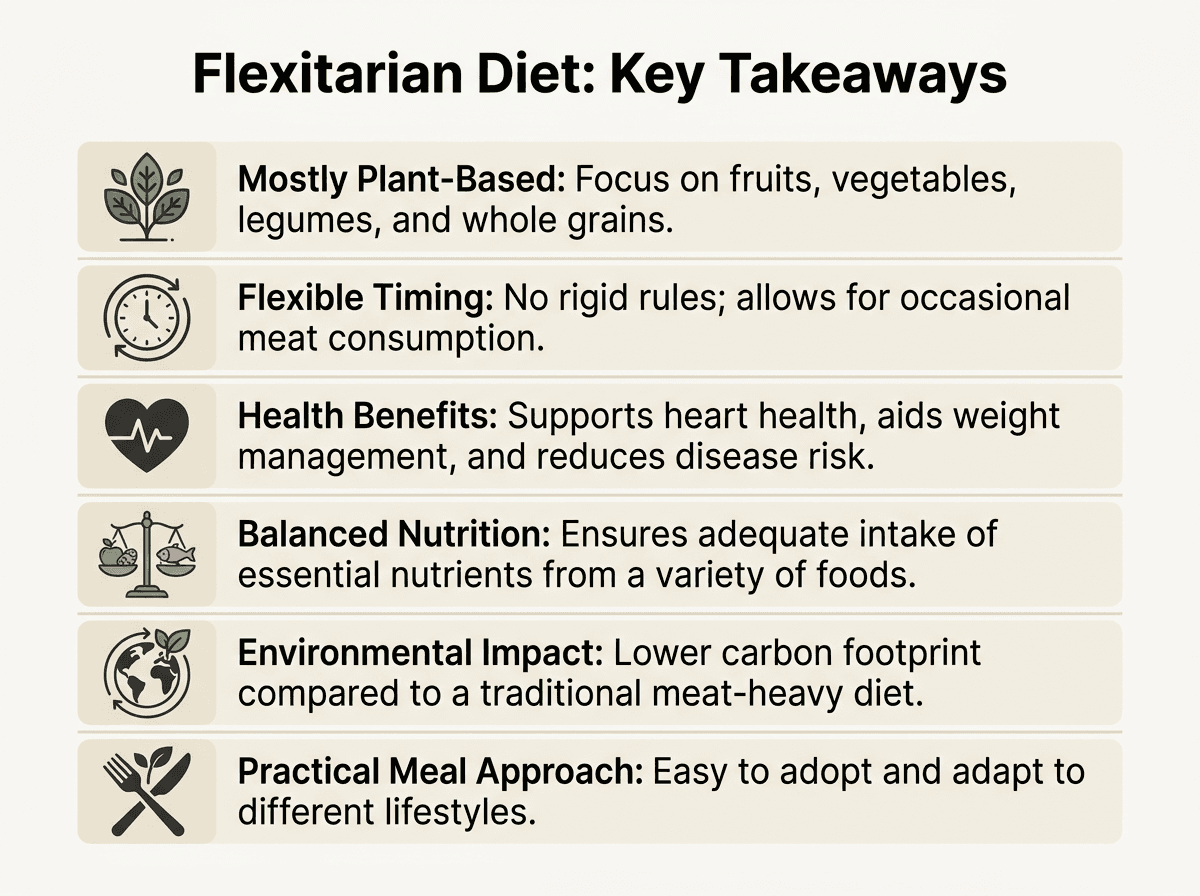
Six essentials of the flexitarian approach — from health benefits to environmental impact.
What to remember about the flexitarian diet:
A flexitarian diet is mostly plant-based, with meat or fish now and then; nothing is strictly off-limits.
The semi vegetarian approach is linked with lower risks of heart disease, type 2 diabetes, and certain cancers (Cleveland Clinic).
Prioritize legumes, whole grains, vegetables, eggs, and dairy; use meat more like a topping or side than the main event.
The "shared base + separate protein" method lets two people eat differently without cooking two separate dinners.
Pay attention to iron, B12, zinc, and omega-3s by using fortified foods, eggs, dairy, and occasional fish.
Cutting back on meat even a few nights a week can deliver real environmental benefits without a total overhaul.
Frequently Asked Questions
What is the flexitarian diet in simple terms?
It's vegetarian-leaning eating with some flexibility built in. Most meals are centered on plants, but meat, fish, and other animal foods can still show up occasionally. There are no strict rules or calorie targets; the goal is simply to make plants the default and keep animal foods as an option.
How is flexitarian different from semi-vegetarian?
People often use the terms as synonyms. "Semi vegetarian" usually means you eat less meat than a typical omnivore diet. "Flexitarian" tends to signal a more intentional plant-first mindset. In day-to-day life, they usually describe the same general pattern.
Can a flexitarian meal plan work for couples with different preferences?
Yes, and it's one of the best reasons to try it. Start with a shared plant-based base (grains, roasted vegetables, a sauce), then add protein at the end. One person tops with chicken or fish; the other goes with chickpeas or tofu. Since cook times are only a few minutes apart, both plates can hit the table together. Tools like the Posha Robot Chef can also auto-adjust timing when you swap proteins, which takes the guesswork out of it.
What are the best plant-based proteins for a flexitarian diet?
Lentils, chickpeas, black beans, tofu, tempeh, edamame, eggs, Greek yogurt, and cottage cheese are all solid picks. They bring plenty of protein, plus fiber, micronutrients, or probiotics that help round out plant-forward meals. Rotating a few across the week keeps things interesting and nutritionally balanced.
Do flexitarian recipes require special ingredients?
Nope. Most flexitarian cooking runs on regular grocery staples: canned beans, whole grains, olive oil, aromatics, and whatever vegetables look good. The bigger shift is portioning: legumes or tofu become the main protein more often, and meat becomes the add-on. Having a flexible recipe library through something like the Posha Circle Membership can make that easier to keep up week after week.
For couples trying to eat more plant-forward without managing two separate dinners, Posha can make flexible cooking easier to repeat week after week. https://www.posha.com/private-chef