Rohin Malhotra
Macros are just shorthand for macronutrients: the three big buckets of nutrients your body uses in large amounts for energy and basic upkeep. Those buckets are carbohydrates, protein, and fat. If you have ever asked "what are macros," that is the whole answer; the rest is learning what each one looks like in the food you actually cook.
If "macros" has always sounded like gym-floor shorthand, you are in good company. The concept gets a lot less spooky once you stop picturing spreadsheets and start picturing dinner. Macros are simply a way to describe food in plain terms so you can make choices that feel better, without turning meals into a math test.
Why Macronutrients Actually Matter
Most calories in food come from the three main macronutrients. Carbohydrates and protein provide approximately 4 calories per gram, while fat provides approximately 9 calories per gram. Alcohol also provides energy of approximately 7 calories per gram, but it is not considered one of the three main macronutrients discussed in this guide.
Once you understand what macronutrients are and where the energy in your meals comes from, it becomes easier to build satisfying plates around everyday ingredients. A meal that combines a fiber-rich carbohydrate source with protein and some dietary fat may feel more satisfying than a meal built mainly around refined carbohydrates. Individual hunger and fullness responses still vary according to portion size, activity, sleep, health, and the foods used. That is not a trendy rulebook; it is digestion doing what digestion does.
Info: The Acceptable Macronutrient Distribution Ranges suggest that, for most adults, carbohydrates may provide 45–65% of total calories, protein 10–35%, and fat 20–35%. These are broad reference ranges rather than exact daily targets, and individual requirements can vary.
Carbs, Protein, Fat: What Each One Does
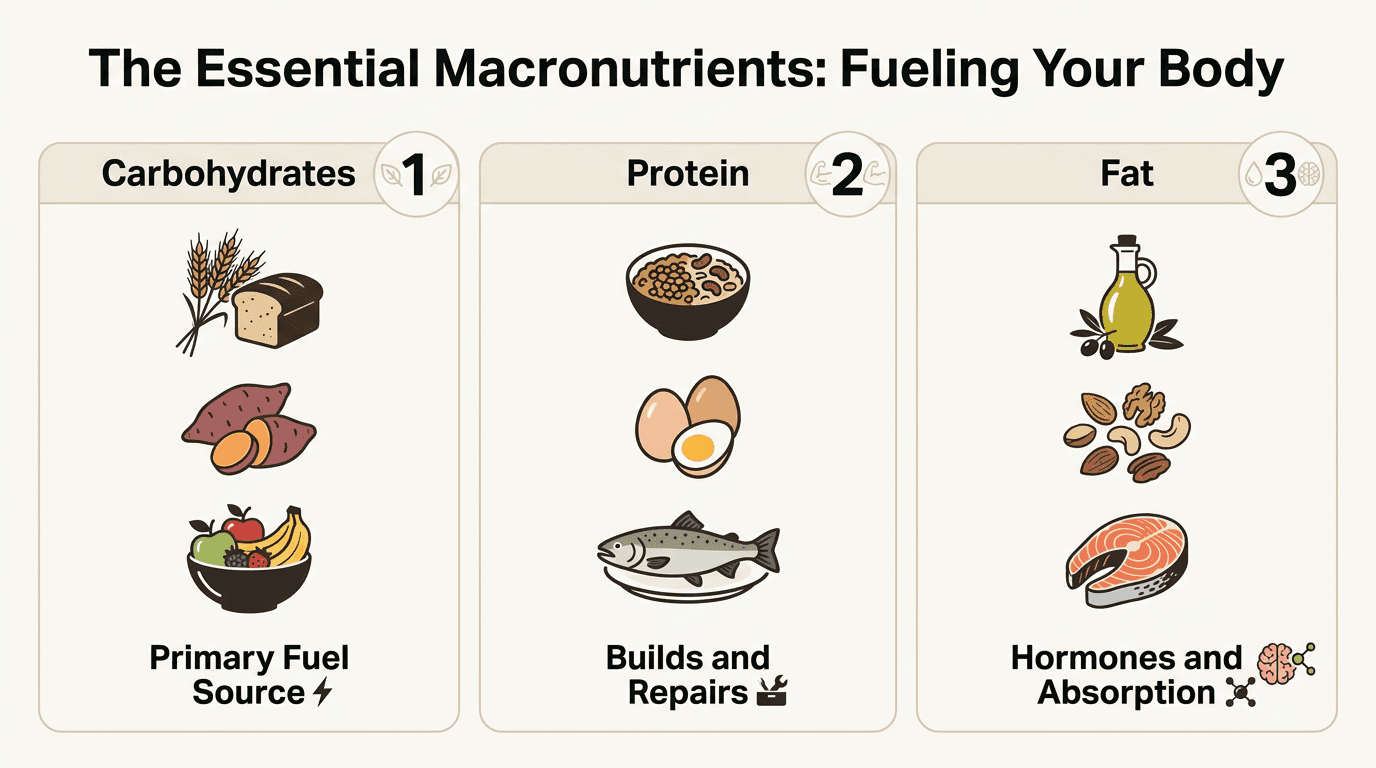
Carbohydrates are one of the body's main energy sources. During digestion, many carbohydrates are broken down into glucose, which the body's cells use for energy. The useful distinction is not "carbs are bad"; it is which carbs you are leaning on.
Whole grains, legumes, vegetables, and fruit bring fiber, vitamins, and minerals along for the ride. Refined carbohydrate foods are often lower in fiber than whole-food sources and can raise blood glucose more quickly, especially when eaten on their own. If you want a low-friction way to experiment, low-carb pasta alternatives can help you swap one familiar staple without overhauling your whole routine.
Protein is the building material. It is made of amino acids, and your body uses it to build and repair muscle, bone, skin, enzymes, and hormones. Harvard's T.H. Chan School of Public Health makes a practical point: the "protein" number is not the entire story; the rest of the food matters, too.
Salmon comes with omega-3s; a processed deli slice tends to come with a lot of sodium. If you want dinner ideas that make the concept concrete, easy high-protein meals offers straightforward options. And if most of your meals are plant-forward, best plant-based protein sources lays out the everyday choices.
Fat gets the worst PR, but your body relies on it. Fat helps you absorb vitamins A, D, E, and K, supports hormone production, and keeps cell membranes doing their job. Here, quality is the point: unsaturated fats from olive oil, avocado, and nuts are associated with heart health, while industrially produced trans fats are associated with increased cardiovascular risk. That drizzle of olive oil over roasted vegetables is not "cheating"; it helps your body take in what those vegetables are offering.
Macros on a Real Plate: Practical Examples
Meal | Primary Carb Source | Primary Protein Source | Primary Fat Source |
|---|---|---|---|
Dal and brown rice | Brown rice, lentils | Lentils (plant protein) | Ghee in the tadka |
Grilled salmon with roasted vegetables | Sweet potato, broccoli | Salmon fillet | Olive oil, salmon fat |
Scrambled eggs on whole-grain toast | Whole-grain bread | Eggs | Egg yolks, butter |
Chicken and quinoa bowl | Quinoa | Chicken breast | Avocado, dressing |
Most home-cooked meals already cover all three macros, even if nobody in your family ever used the word. Take a basic dal: carbs from the lentils and rice, protein from the lentils, fat from the ghee in the tadka. Traditional cooking has been balancing plates for a long time; "macros" is simply the newer label.
Common Misconceptions About Macros

Misconception 1: Tracking macros means weighing everything. It can, but it does not have to. If you know what foods tend to be carb-forward, protein-forward, or fat-forward, you can build a solid plate by sight. Some people use hand-size portions as a rough visual guide, but these are only heuristics, and individual portion needs vary. This approach does not require a kitchen scale.
Misconception 2: Fat makes you fat. People often confuse dietary fat with body fat, and that idea has been thoroughly debunked. Fat is calorie-dense, so portions still matter. But fat is not the automatic villain, and cutting it out often means replacing it with refined carbohydrates, which brings its own headaches.
Misconception 3: All carbs are equal. Carbs in a bowl of oats and carbs in a glazed doughnut both count as carbohydrates, but they do not behave the same way once you eat them. Fiber, micronutrients, and how quickly glucose hits your bloodstream vary a lot. Treating them as interchangeable is like saying a chicken breast and a hot dog are the same food because both can claim "protein" on the label.
How to Count Macros Without Losing Your Mind
Knowing how to count macros can be genuinely useful, as long as the point is awareness instead of perfection. Start with nutrition labels on the foods you buy all the time. Before long, you will have a simple mental map: Greek yogurt leans protein, avocado leans fat, oats lean carbs. From there, "balanced" starts to feel intuitive, not like a daily equation.
If you want practical ways to apply macro awareness in a real kitchen without turning dinner into a spreadsheet, how to track macros without overcomplicating things lays out approaches that fit into a busy week. And if you are comparing home-cooked meals with delivery, cooking at home gives you straightforward control over what ends up in each macro category.
Tip: Posha’s Culinary AI detects cooking stages, manages heat, adds ingredients at the right time, and stirs automatically, helping you prepare fresh meals with less active stove time.
Key Takeaways
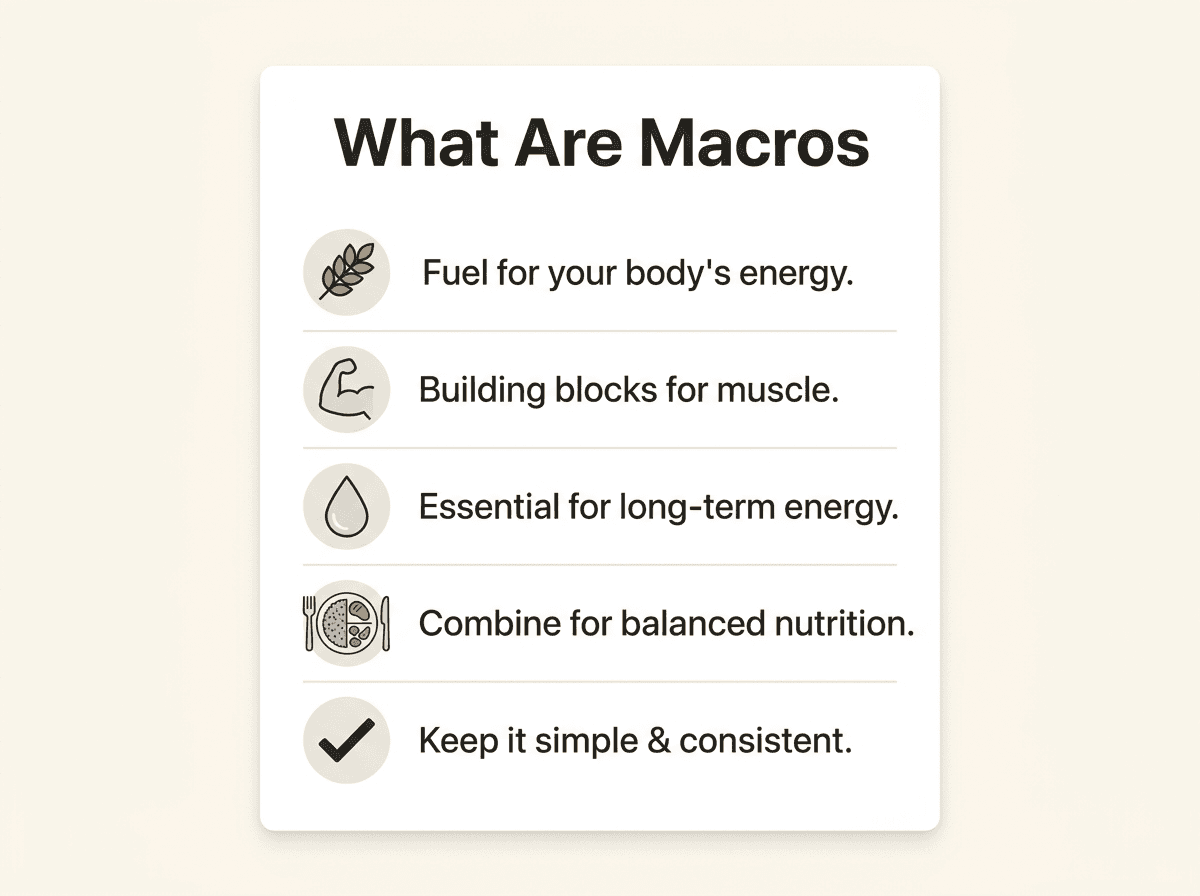
Everything you need to remember about macros:
Macronutrients are the three nutrients your body needs in large amounts: carbohydrates, protein, and fat.
Carbs are your primary fuel source, breaking down into glucose. Favor whole-food sources for fiber and steadier energy.
Protein builds and repairs tissue. It provides 4 calories per gram and supports muscle, hormones, and enzymes.
Fat provides 9 calories per gram, helps with vitamin absorption, and supports hormonal health. Quality matters more than avoidance.
Balanced plates naturally contain all three macronutrients. Most traditional home-cooked meals already do this without deliberate tracking.
How to count macros does not require a scale. Reading labels and having a feel for portions gets you most of the benefit.
Frequently Asked Questions
What are macros in simple terms?
Macros are short for macronutrients: carbohydrates, protein, and fat. Foods contain one or more of them in different amounts, and together they account for most of the calories in a typical diet.
What are macronutrients versus micronutrients?
Macronutrients are the big three you need in larger amounts, and they provide calories (carbs, protein, fat). Micronutrients are vitamins and minerals you need in smaller amounts. They do not provide calories, but they help your body use macronutrients properly. Eating plenty of whole foods tends to cover both.
Do I need to hit exact macro targets every day?
Not unless you have a specific medical or athletic reason to be that precise. For most people, the National Academies' Acceptable Macronutrient Distribution Ranges are meant to be flexible. For most people, the National Academies’ ranges are broad reference ranges rather than exact meal-by-meal targets. Individual needs can vary.
Which macro is most important for weight management?
All three matter, but protein gets a lot of attention because it supports muscle retention and is often more filling per calorie than refined carbohydrates. Still, total calorie intake and food quality across carbs, protein, and fat all play a role. No single macro does the job by itself.
Can the Posha cooking system help me cook macro-balanced meals?
The Posha self-cooking stove watches your dish as it cooks, stirs when needed, and guides you through each step of a recipe. By handling cooking steps such as monitoring progress, stirring, ingredient timing, and heat adjustment, Posha can make it easier to prepare home-cooked meals consistently. The macro balance of the meal still depends on the recipe, ingredients, and portions you choose, which form the practical basis of any macro-aware approach.