Rohin Malhotra
If you ask "how much does a cooking robot cost," the truthful answer is annoyingly unclean. It is three numbers stacked together: the hardware, the optional recipe membership, if you want unlimited access to Posha's full guided-recipe library, and whatever you stop spending on takeout, meal kits, or the quiet tax of groceries that die in the crisper because Tuesday got away from you. Most product pages only say the first number and hope you do not ask about the rest. That is not how normal people budget.
Below, I put all three numbers on the table for the Posha Robot Chef and for the broader kitchen-robot category, then run a full-year tally for three different households. The math comes first. No friendly rounding. If it does not pencil out for your kitchen, you will see that in black and white.
What this covers:
What the category costs, from entry-level to high-end
Posha's verified device price and what ships in the box
Recipe access: what is included, what costs extra
Total cost of ownership across three household types
What a kitchen robot replaces (and what it does not)
Trial, returns, and warranty terms
Who this is genuinely not for
So, How Much Does a Cooking Robot Cost in General?
"Cooking robot price" is a messy phrase because the category is still arguing with itself about what it is. On one end: countertop all-in-ones that chop, weigh, stir, steam, and sauté in a single bowl. On the other: commercial robotic arms flipping burgers in a ghost kitchen. Same label, completely different expectations.
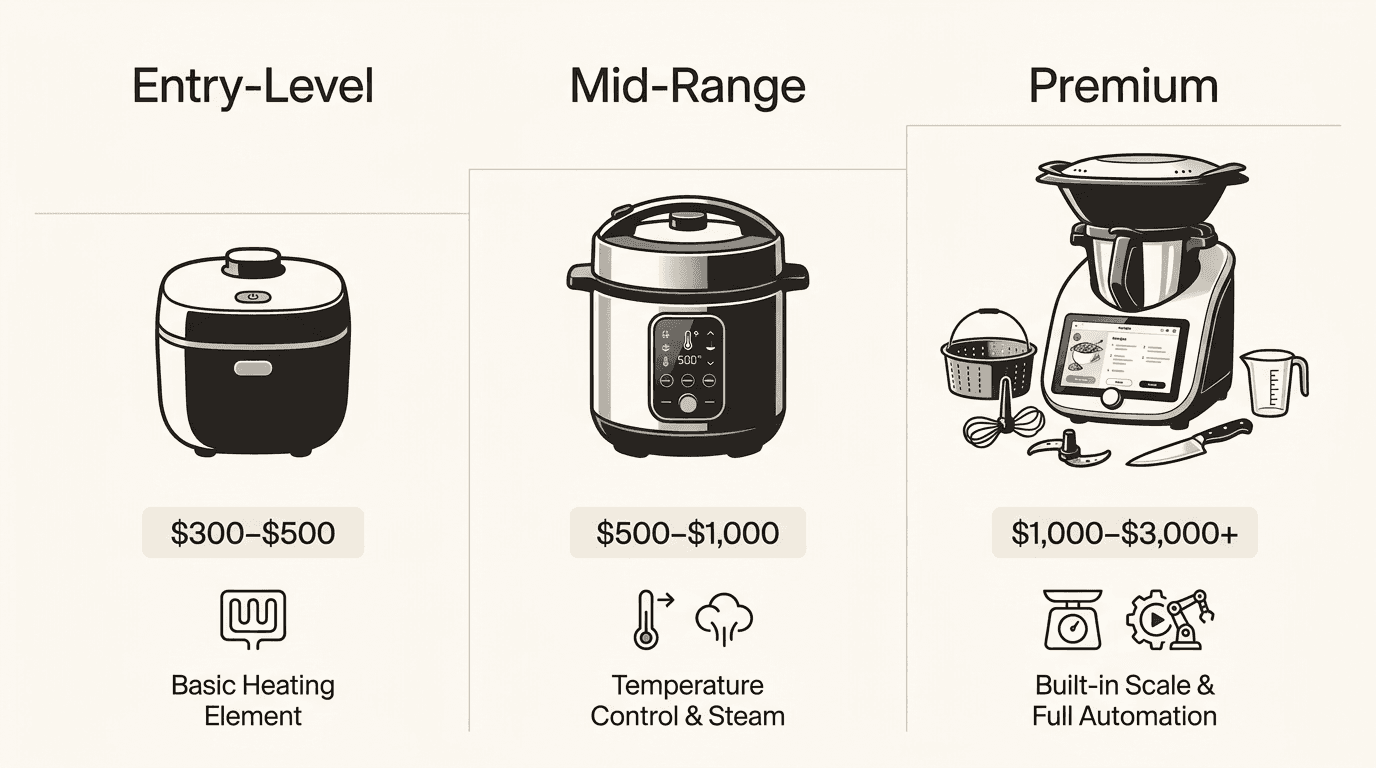
For home use, TOKIT (2024) splits automatic cooking machine pricing into three buckets. Entry-level models that do basic chopping and stirring land around $300 to $500. Mid-range units that add steaming, tighter temperature control, and guided recipes tend to sit between $500 and $1,000. High-end systems with built-in scales, cooling, and fuller automation start above $1,000 and can climb to $3,000+.
What you are paying for usually comes down to a handful of very practical things. Heat is one: induction is quicker and more controlled than a basic heating element, and it costs more to build. A built-in scale is another; it changes the whole flow because the machine can verify quantities as you go. Cooling (still rare) is what opens up doughs and desserts that need a temperature drop mid-process.
Then there is the software layer: the guided recipes and sensor logic that decide when to adjust. That is where a lot of the R&D money disappears. If you want a clearer mental model, understanding the difference between a self-cooking pot and a full cooking system helps explain why a $350 device and a $1,500 device are not really showing up for the same job.
What Is the Posha Robot Chef Price, and What Ships in the Box?
The Posha Robot Chef is $1,750, currently offered at a limited-time price of $1,500. Purchase works as a $25 refundable deposit now, with the balance due when the unit ships. The next batch currently ships in March 2027, with limited units available.
In the box: the Posha device (preloaded with 50 recipes), 1 Posha pan, 2 spatulas plus 1 extended arm, 4 containers, 20 refillable spice pods, and 1 oil-and-water container. New Posha Circle members get a 90-day free trial, with no payment method required to start and no charge until the trial ends. Details are in the membership section below.
At $1,500 (limited-time) to $1,750 (list), Posha is priced in line with or slightly above the Thermomix TM6, which runs $1,500 to $1,649 direct from Thermomix in the U.S., and far above entry-level smart ovens like Tovala (which lowers the hardware price by requiring meal-plan purchases). With Posha, the price is the hardware plus an optional membership. Every owner also gets free access to a curated "Essential recipes" collection without a subscription. There is no mandatory food-pack subscription hiding in the fine print.
What About the Recipes and Software? Is That Extra?
This is where people pause, and they should. Without recipes, a robot chef is just an expensive pot with opinions. Here is the actual structure Posha uses.
Every device includes Co-Pilot mode. Co-Pilot is manual control: you set time, temperature, and speed yourself. Use it like a programmable cooker and follow whatever recipe you trust online, adapt a family staple, or wing it. That mode does not require a subscription, now or later. Every owner also gets free access to a curated "Essential recipes" collection, so there is a baseline of guided cooking available without ever paying for a membership.
Posha Circle Membership is what unlocks the full recipe library beyond the free Essential collection: step-by-step instructions on the touchscreen, automatic temperature and speed changes, and access to new recipes added weekly. Pricing is $14.95 per month or $139.95 per year. New members get a 90-day free trial, with no payment method required to start. The library covers a range of cuisines and meal types, and it updates on a weekly cadence.
That split matters when you do the cost math. If you cook by feel and mostly want a precise, multi-function machine, the hardware alone (plus the free Essential collection) gets you there. If you want access to Posha's full guided-recipe library, Posha Circle unlocks that library. Without a membership, owners can still use Co-Pilot mode and the free Essential recipes collection.
The Real-World Math: Your Total Cost of Ownership
The only cooking robot cost that matters is the net number after a year of dinners. Not the sticker. Not the monthly fee. It is what you paid, minus what you did not have to pay because the robot replaced something you were already buying. Below, I modeled three households, each cooking dinner for two adults.
Grocery-cost assumptions are modeled estimates for this comparison. USDA food-plan data can provide broader context for food-at-home spending, but it does not directly represent five dinners per week for this household. Takeout uses a $16.50 per-person average that lines up with recent delivery-app data (tip included). Meal-kit pricing uses published per-serving rates from major services.
If you want to stare at the delivery side of this longer, the cost of cooking at home versus food delivery companion piece breaks the per-meal numbers down further.
The Takeout Regular | The Meal-Kit Subscriber | The Home Cook | |
|---|---|---|---|
Dinner pattern | 4 delivered meals/week, eat out or scramble the rest | 3 meal-kit dinners/week for two adults, cook simply the rest | Cooks 5 nights/week from scratch, orders in twice |
Annual food/meal cost | ~$6,864 (delivery) + ~$2,600 (other nights) = ~$9,464 | ~$3,744(3dinners/week×2servings×~12 × 52 weeks) + ~2,080(othernights)=~5,824 | ~$5,200 (groceries) + ~$1,716 (takeout) = ~$6,916 |
Annual subscription fees | $0 (delivery fees baked into meal cost) | $0 (included in kit price) | $0 |
Year 1 Posha hardware | $1,500 | $1,500 | $1,500 |
Year 1 Posha membership | $139.95 | $139.95 | $139.95 |
Year 1 Posha grocery cost (5 dinners/week) | ~$3,380 | ~$3,380 | ~$3,380 |
Year 1 Posha + remaining nights | ~$3,380 + ~$1,300 (2 non-Posha nights) = ~$4,680 | ~$3,380 + ~$1,300 = ~$4,680 | ~$3,380 + ~$1,300 = ~$4,680 |
Total Year 1 with Posha | ~$6,320 | ~$6,320 | ~$6,320 |
Year 1 difference | -$3,144 (saved) | -$1,376 (saved) | |
Year 2 onward (no hardware) | ~$4,820/year | ~$4,820/year | ~$4,820/year |
The Heavy Takeout Household
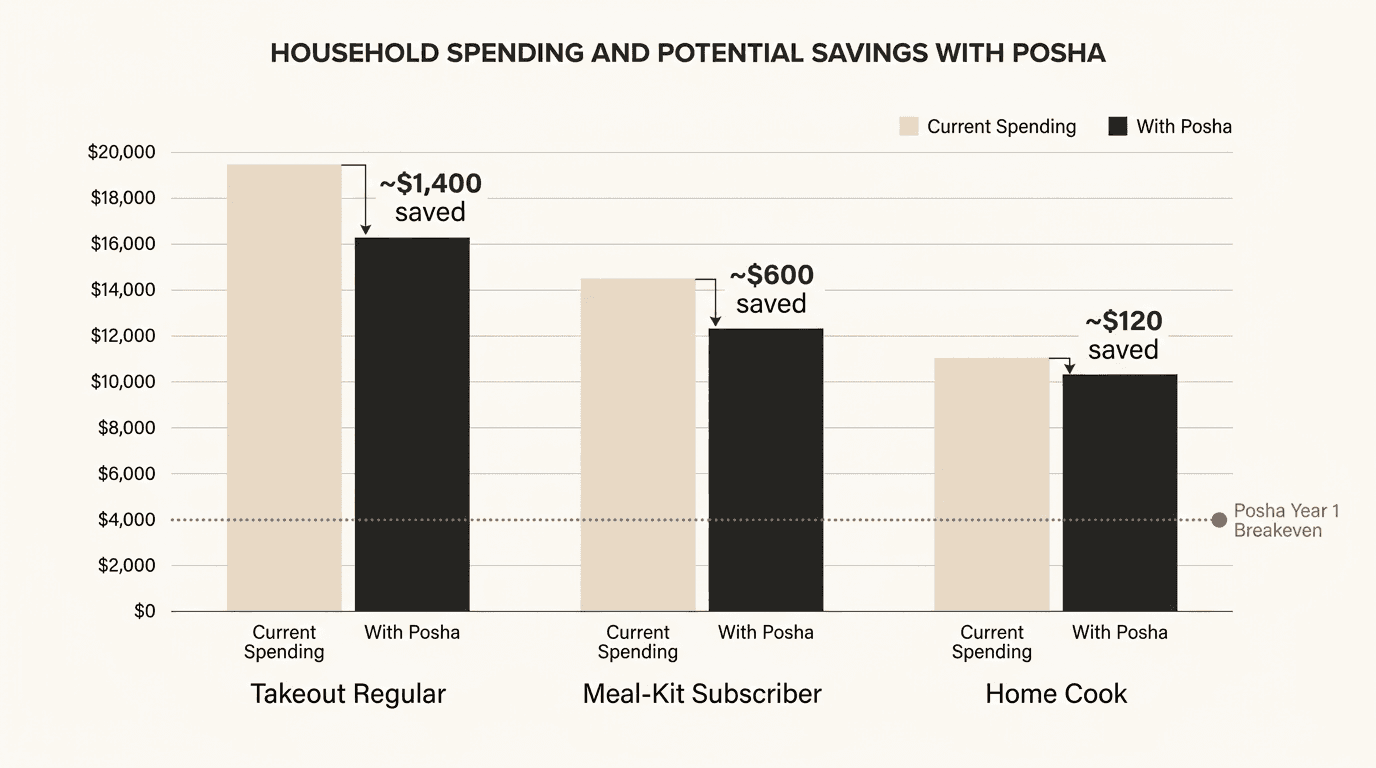
Four delivery dinners a week for two people comes out to nearly $6,900 a year for those nights alone. Add the "we ate cereal" and "we grabbed something" filler nights, and you are hovering around $9,500 annually. Swap five dinners a week to Posha-cooked meals using your own groceries and the food line drops hard. Even after you stack on the $1,500 hardware and the roughly $140 membership, Year 1 still lands about $3,100 lower. In Year 2, when the hardware cost disappears, the gap opens further. If you want a clean financial argument, this is the household that gets one.
The Meal-Kit Subscriber
Meal kits already get you most of the way to home cooking, but the per-serving pricing (often $10 to $14 across major services) is where the bill sneaks up. Three meal-kit dinners a week for two people at about $12 per serving comes to roughly $3,744 a year before counting the rest of your dinners.
With Posha, you buy your own groceries and let the machine handle the execution, which cuts that ingredient line roughly in half. The Year 1 savings come out to around $1,400. The other difference kit subscribers tend to care about is flexibility: you are not stuck with whatever protein the box decided to ship this week. For a broader comparison, see automated home cooking vs. meal delivery.
The 'Cooks Most Nights' Household
If you already cook five nights a week from scratch, the grocery spend does not magically shrink. You are buying the same onions and chicken either way. For someone who already cooks most meals at home, the financial difference is much smaller and depends heavily on their existing grocery and takeout spending. The comparison should be recalculated using consistent grocery assumptions before assigning a savings figure, mostly from cutting down those two takeout nights and shaving off some waste (guided portions help). For this household, the honest pitch is not a spreadsheet. It is variety and brain space. If you have been cycling the same dozen dinners because you cannot face learning new ones on a weeknight, the guided library is the part that changes the routine. If your current system is working and you like cooking, the numbers alone will not make the decision for you.
What It Replaces (and What It Does Not)
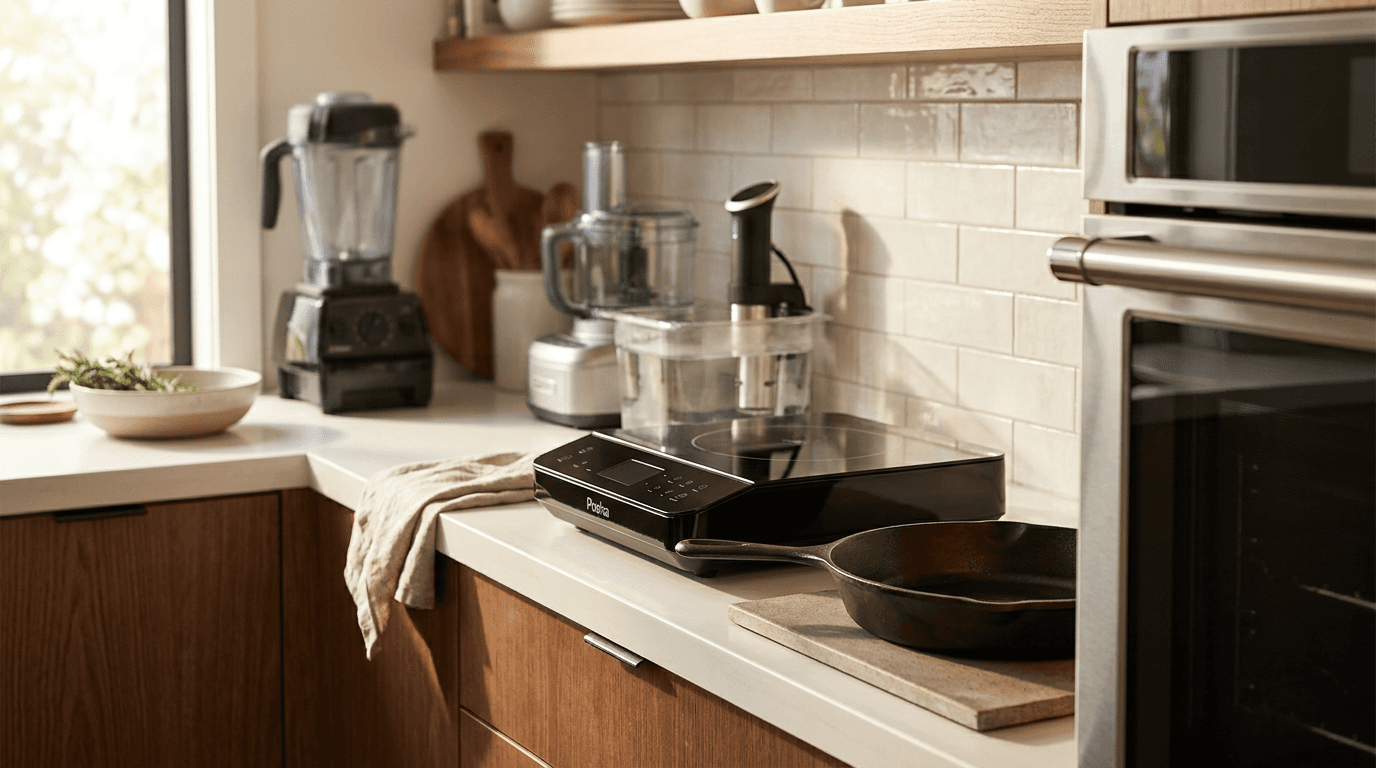
A cooking system like Posha can take over several tasks that normally keep you at the stove, including ingredient dispensing, stirring, seasoning, heat control, and progressing through supported cooking stages. Posha is designed to reduce hands-on stovetop work rather than replace appliances such as a blender, food processor, oven, grill, or sous-vide circulator. Soups, risottos, curries, sauces, doughs, and steamed dishes are where it feels most natural. If you want the unglamorous, weeknight version of this, what an automatic cooking machine actually does is walk through specific meals.
What it does not replace is just as important. It will not stand in for your oven when you want a sheet-pan roast or a whole chicken. It will not give you the kind of crust you get from cast iron. It does not replace a grill. It also does not erase prep: you still need a knife and a cutting board for plenty of tasks, because ingredients still need to be chopped or otherwise prepared before they are loaded into Posha. And sometimes you will still want to cook the slow, manual way because you feel like it. A solid Tuesday-night machine does not need to be your entire personality.
If you are skeptical, "Can a cooking robot really make dinner?" is worth your time. The short answer is yes. The more useful answer is that its comfort zone is specific, and knowing that range before you buy is more valuable than any glossy claim.
What Is the Commitment? Trial, Returns, and Warranty
Posha sells the device with a home trial period. The return and cancellation policy spells out the window and the mechanics of sending it back if it does not fit your household. That page also lists any conditions (original packaging, included accessories). Delivery timelines live on the product page.
The warranty covers manufacturing defects for the stated warranty period. The warranty page is where the real details are: what is covered, what is not, and how claims work. I am not going to rewrite legal terms into mushy summaries; the exact wording is what matters, and it is worth reading directly.
Tip: If you are on the fence, treat the trial period as the number that matters. It is enough time to cook a dozen different recipes and see whether this fits your real week, not the version of your week you keep promising yourself.
Let's Be Honest: Who Is This Not For?
Any page that cannot name a bad fit is not trying very hard to tell the truth. Here are the households where a cooking robot, Posha or otherwise, is probably the wrong buy.
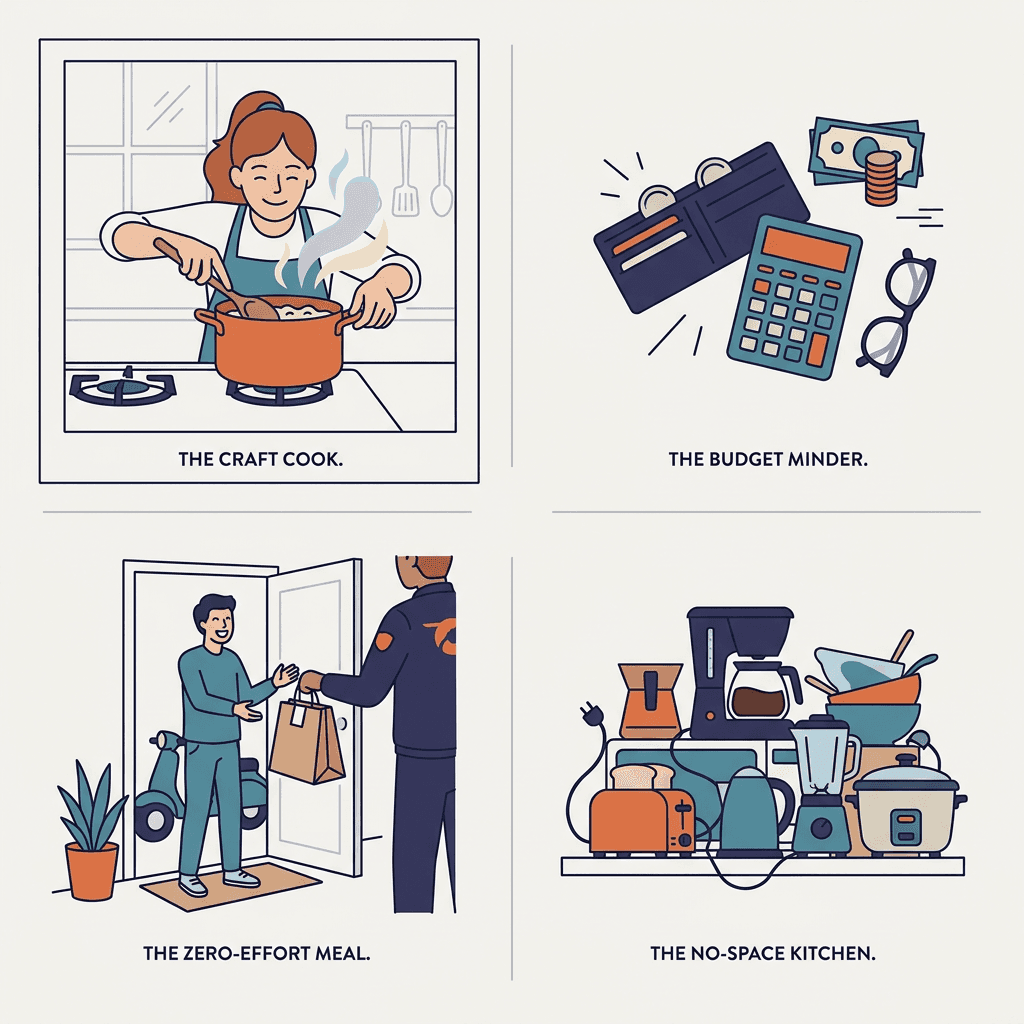
The process-driven home cook. If you love the act of stirring risotto for 45 minutes, if knife work is the point, if the craft is the reward, automation strips out the part you actually enjoy. This solves a problem you do not have.
The household where $1,500 upfront is a real stretch. The long-term math can look better on paper, but if paying upfront adds stress, those savings are just an idea until months of dinners go by. A good Dutch oven and a library card will feed you for a fraction of the price.
The person who does not want to deal with food at all. A cooking robot still asks you to shop, load ingredients, and plate dinner. If what you want is a fully prepared meal showing up at your door (CookUnity exists for exactly that), a kitchen robot will feel like more work, not less.
The tiny kitchen with no counter space. These machines are not small. If your counter is already a negotiation between a toaster and a coffee maker, adding something the size of a large stand mixer creates friction every single day.
Frequently Asked Questions
Do I have to use Posha's recipes, or can I cook my own?
You can cook your own. Co-Pilot mode gives you manual control over time, temperature, and speed, so you can follow recipes from anywhere (or make up your own). Every owner also gets free access to a curated "Essential recipes" collection. Circle Membership unlocks the full guided-recipe library with automatic adjustments, but it is optional.
How much counter space does the Posha Robot Chef need?
Plan on about the footprint of a large stand mixer, and ideally a spot where it can live full-time. A machine you have to drag out every night tends to get used less. Compare your counter space to the dimensions on the product page before you order.
Are the parts dishwasher safe?
The Posha pan and four ingredient containers are listed as dishwasher-safe. For the other removable components, follow the latest care instructions provided by Posha. The device ships with care instructions, and the same guidance is available on the Posha site.
Does a kitchen robot actually make food that tastes good?
It depends on the recipe and the ingredients, the same way it does when you cook manually. Foods that want steady heat and consistent stirring (risottos, curries, sauces, soups) tend to turn out especially well because the machine stays precise without getting tired. High-heat browning and seared texture are not its strong suit. The outcome is real dinner, not a novelty demo.
Can I use my own groceries, or do I have to buy special food packs?
Use your own groceries from any store. There are no proprietary food packs and no required ingredient subscription. That is a meaningful difference from models like Tovala that tie hardware pricing to mandatory meal plans.