Rohin Malhotra
Koshary is Egypt's national dish: a sturdy, plant-based bowl built in layers of rice, brown lentils, short pasta, and chickpeas, finished with a vinegar-bright tomato sauce and a tumble of crisp fried onions. Each piece is cooked on its own and only then stacked together, which is exactly why it eats so well and why it can feel like a lot to pull off at home.
Walk through Cairo at lunchtime and koshary announces itself before it comes into view: ladles ringing against steel pots, vendors calling orders, regulars sliding coins across counters polished by years of hands. This is street food at its most democratic, a meal that costs almost nothing and still fills you up. Knowing how it came to be turns cooking it at home from a checklist into something closer to joining a conversation Egyptians have been having for generations.
A Dish Born From Many Kitchens
Koshary's origin story is famously disputed, and the uncertainty suits a dish that feels like it contains multitudes. One of the most cited theories points to khichri, an Indian rice-and-lentil staple that British colonial troops reportedly carried into Egypt in the late nineteenth century. Explorer Richard Burton wrote about a breakfast in Suez as early as 1853 that mixed lentils, rice, butter, and onions in a way that reads like a rough sketch of koshary. Over time, Egyptian cooks folded in pasta (arriving with Italian immigration), chickpeas, and the tomato sauce that now signals "koshary" at first glance. Another camp argues the logic is older still, tied to ancient Egyptian grain-and-legume cooking that predates colonial traffic. The likeliest answer sits in the middle: an old local instinct, refined by outside ingredients and habits, until the result became unmistakably Egyptian. You can read more about this layered history in the Smithsonian's history of koshary.
What turned koshary from clever combination into national institution was simple arithmetic. Rice, lentils, dried pasta, canned chickpeas, onions, tomatoes, and a splash of vinegar are among the cheapest staples in an Egyptian market, and they scale easily from one bowl to a busy lunch rush. It became the dependable fuel of laborers, students, and anyone who needed a filling meal on a tight budget. Lentils alone deliver remarkable nutritional density, bringing plant-based protein and fiber that keep you going. That mix of thrift and nourishment is why koshary shops, called koshary restaurants or simply "koshary," stand as their own category of eatery across Egypt.
What Goes Into the Bowl
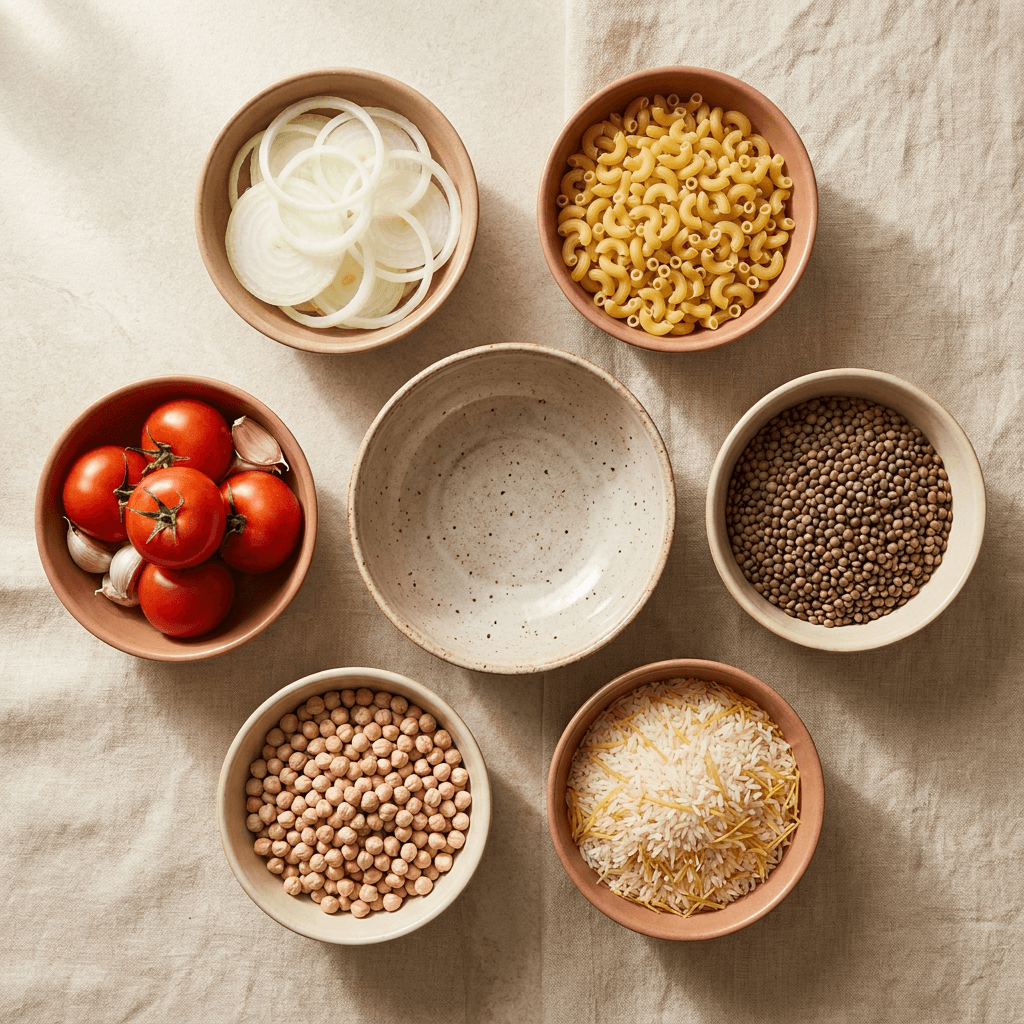
Six separate preparations — each essential — come together to build a classic koshary bowl.
A classic koshary bowl is really six separate preparations that meet at the last minute. The base is short- or medium-grain rice cooked with a handful of vermicelli that you toast in oil until it turns golden and nutty. Brown lentils simmer on their own until tender, but still intact. Elbow macaroni (or another short shape) boils in well-salted water. Chickpeas, often canned for sheer practicality, just need to be warmed through. The tomato sauce, sometimes called "daqqa," starts with crushed tomatoes, garlic, and cumin, then gets its signature lift from a generous pour of white vinegar. And then come the onions: sliced paper-thin, dusted lightly with flour, and fried until deep brown and shatteringly crisp. They are not decoration. They are the dish's heartbeat.
Koshary is assembled with intent, not tossed together. Rice and lentils form the foundation, pasta goes next, and chickpeas follow. The tomato sauce comes over the top, and the onions land last, like a crown you do not want to soften. A bottle of garlic vinegar is usually nearby for anyone who wants extra bite. If you want to think carefully about the rice layer, it helps to know what basmati rice is and how different varieties behave when steamed or simmered, even if basmati is not the traditional default here.
Why Home Cooks Find It Intimidating
Koshary is not hard in the way laminated pastry is hard. None of the steps demand fancy technique. The strain is orchestration: five or six moving parts, each on its own clock, and a narrow sweet spot for the lentils and the onions in particular. In a typical home kitchen, something inevitably waits on the sidelines, cooling off while you chase the next pot.
The crispy onions are the most time-sensitive element. Fry them in small batches over medium-high heat and pull them out just before they look done. They continue cooking from residual heat and will go from golden to bitter in under a minute if left in the pan.
This is the kind of layered, timing-driven cooking where the Posha Robot Chef makes a clear argument for itself. Posha uses AI to manage supported cooking steps with timed ingredient addition, stirring, and heat control, which is exactly the kind of assistance that helps with timing-sensitive dishes and koshary-inspired components. The Posha Circle Membership unlocks unlimited access to the full Posha recipe library, making it easier to explore dishes where timing, heat control, and sequence matter as much as seasoning. If you have ever looked at four pots and a frying pan and decided lunch can wait, that kind of coordination can be the difference between wanting koshary and actually making it.
Common Misconceptions Worth Clearing Up
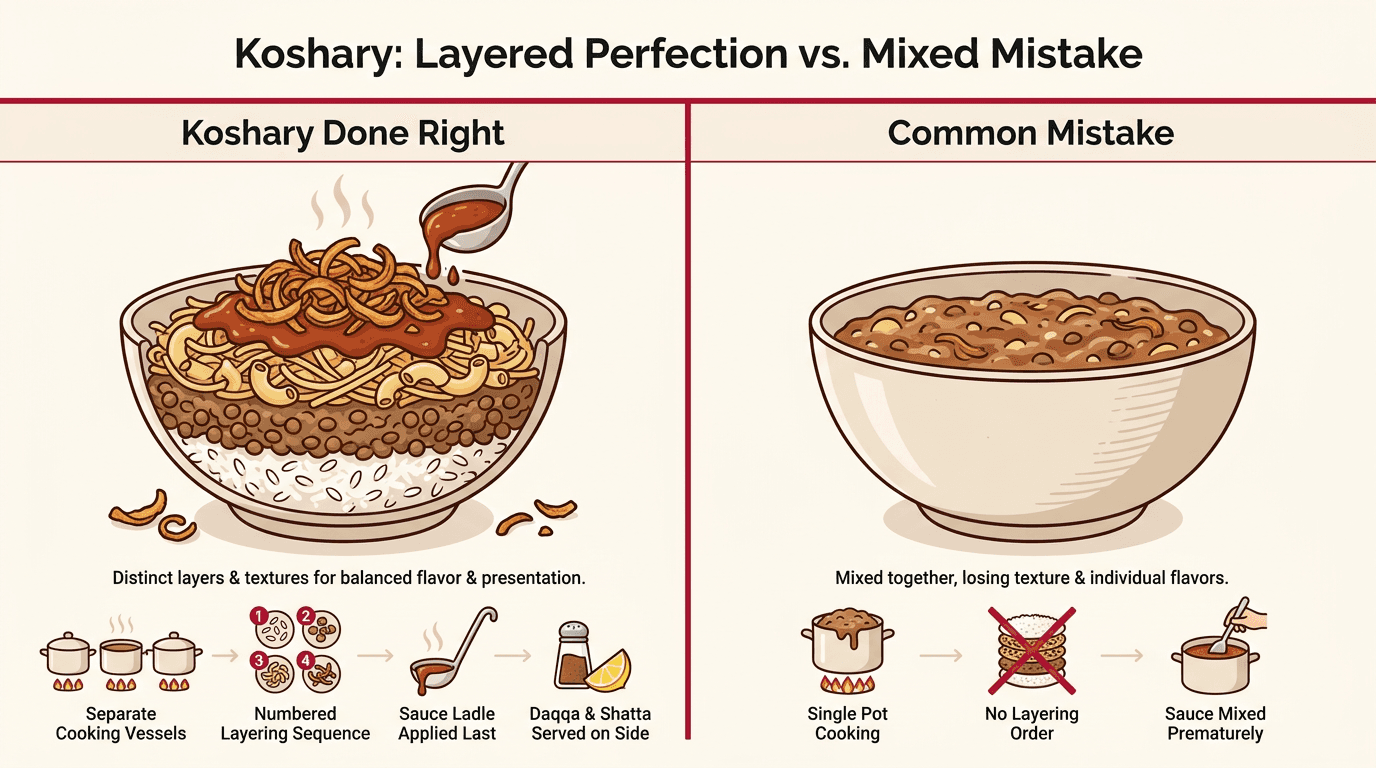
Separate pots, distinct layers — that's what makes koshary koshary, not mush.
Koshary is not a one-pot dish. Outside Egypt, the most common misstep is trying to save time by cooking everything together. The result is starchy and flat, with none of the point of koshary intact. The pleasure is contrast: lentils that still have shape against pasta with a little chew; soft rice under onions that crackle; mild grains sharpened by an acidic sauce. Each component needs its own pot (and its own moment) to show up properly.
The pasta is not filler. Some recipes treat macaroni like a budget stretcher, but in Egyptian koshary it is part of the balance, a neutral chew that keeps the lentils and rice from feeling too heavy or too earnest. Cut it out or shrink it too far and the bowl tilts. If you want to experiment with lower-carb versions, there are solid pasta alternatives that take sauce well, though at that point you are making an adaptation, not a faithful replica.
Koshary is not Indian khichdi. They share a family resemblance and a pantry logic, but they are not interchangeable. Khichdi is usually cooked together into something soft and porridge-like, a comfort food built on cohesion. Egyptian koshary is composed: layers, sauce, crunch, and an intentional architecture of textures that khichdi does not aim for. The lineage is worth knowing; the mix-up is something else.
Key Takeaways
Everything worth remembering about Egyptian koshary:
Koshary is Egypt's national dish and its most iconic Egyptian street food, sold in dedicated shops across the country.
The dish combines rice, brown lentils, short pasta, and chickpeas, turning pantry staples into a complete plant-based meal.
Its origins are debated: the most cited story links it to Indian khichri via British colonial presence in the late 1800s, with ancient Egyptian grain-and-legume cooking likely shaping it too.
The six components (rice-vermicelli base, lentils, pasta, chickpeas, spiced tomato sauce, and crispy fried onions) need to be cooked separately to keep the signature contrasts intact.
The vinegar-spiked tomato sauce and the deeply fried onions are what set koshary apart from other lentil-rice-pasta combinations.
For most home cooks, the hard part is timing several pots at once, not mastering any single technique.
Tools like the Posha Robot Chef can help with supported timing-sensitive cooking steps, making koshary-inspired meals feel less like a kitchen juggling act.
Frequently Asked Questions About Koshary
What is the difference between koshary and kushari?
None. Koshary and kushari are two common English spellings of the same Arabic word, and you will also see "koshari." All of them point to Egypt's street-food staple of rice, lentils, pasta, chickpeas, tomato sauce, and crispy onions.
Is koshary vegan?
Traditionally, yes. Classic Egyptian koshary uses rice, lentils, pasta, chickpeas, tomatoes, garlic, and onions, with the onions fried in vegetable oil. Some home versions use butter for frying, but the street-food standard stays fully plant-based.
What type of lentils should I use for a koshari recipe?
Brown or green lentils are the usual choice because they keep their shape after cooking, which matters in a layered bowl. Red lentils break down quickly and turn the base soft and indistinct.
Can I make koshary ahead of time?
Yes, if you keep the components separate. Cook the rice, lentils, pasta, and chickpeas up to a day ahead and refrigerate them, then reheat gently before assembling. The tomato sauce can be made fresh or rewarmed on the stove. Save the onions for the day you plan to eat; they lose their crunch fast once stored.
How does the Posha Robot Chef help with a multi-component dish like koshary?
Posha uses AI for autonomous cooking, tracking food cues like ingredient state, heat response, texture, color, and cooking progress so timing-sensitive components are easier to manage. A Posha Circle Membership includes unlimited access to the full recipe library, making it easier to explore dishes where sequence, heat control, and timing matter as much as seasoning.