Rohin Malhotra
It is 7 p.m. on a Wednesday. You open the fridge, stare down a block of tofu, half a bag of spinach, and last Sunday's optimism, then order Thai for the third time this month. Sound familiar? A weekly meal planner sounds like the fix, but most people build one that works for Monday-you and quietly unravels by the time Thursday-you drags home.
This is for dual-income couples who want to eat well without turning dinner planning into a second job. The goal is a framework you can reuse, a concrete template, and a night-by-night setup that matches the energy you actually have, not the energy you imagined on Sunday. A 2025 analysis of American Time Use Survey data found that the share of U.S. adults cooking at home increased between 2003 and 2023. Interest in home cooking is not the missing ingredient here. The design of the week is.
Why most weekly meal planners fail by Wednesday
Most plans do not fail because you chose the "wrong" recipes. They fail because the plan treats every night like it comes with the same time, focus, and patience. A 2018 Acosta and Technomic survey found that 85% of respondents decided what to eat on the same day as the meal, which means most households are making a fresh decision under pressure every single night. That decision debt adds up. By Wednesday, the mental cost of figuring out what to cook, whether you have the ingredients, and how long it will take can feel steeper than tapping "order again."
Over-planning makes the whole thing more brittle. When every night is tied to a specific recipe, one late meeting can domino into a week of takeout. Most meal plan templates are built for fantasy weeknights, not the ones where you are tired, and the sink is already full. You do not need a better list of recipes. You need a structure that can flex without snapping.
The foundation: what resilient weekly meal planning actually needs
Before you pick recipes, get three basics in place. Start with an honest energy map of your week. Then plan for ingredient overlap so one grocery run can feed multiple nights. Finally, name a flex night upfront, instead of pretending you will cook seven days straight and then improvising when reality arrives.
Weekly meal planning is not the same thing as weekly meal prep, and mixing them up is how people end up overwhelmed before they start. Planning is the architecture: which nights get which dinner types, which proteins anchor the week, which meals share ingredients. Prep is the labor: the Sunday hour you spend washing greens or cooking a grain. You want both, but they live in different buckets and solve different problems.
Tip: Dinner planning by energy tier is the structural shift that makes a weekly plan hold. High-effort nights (Sunday, Monday) get real cooking. Low-effort nights (Wednesday, Thursday) get hands-off or remix meals. Build the week around that reality, not against it.
Build your weekly dinner planner: a night-by-night framework
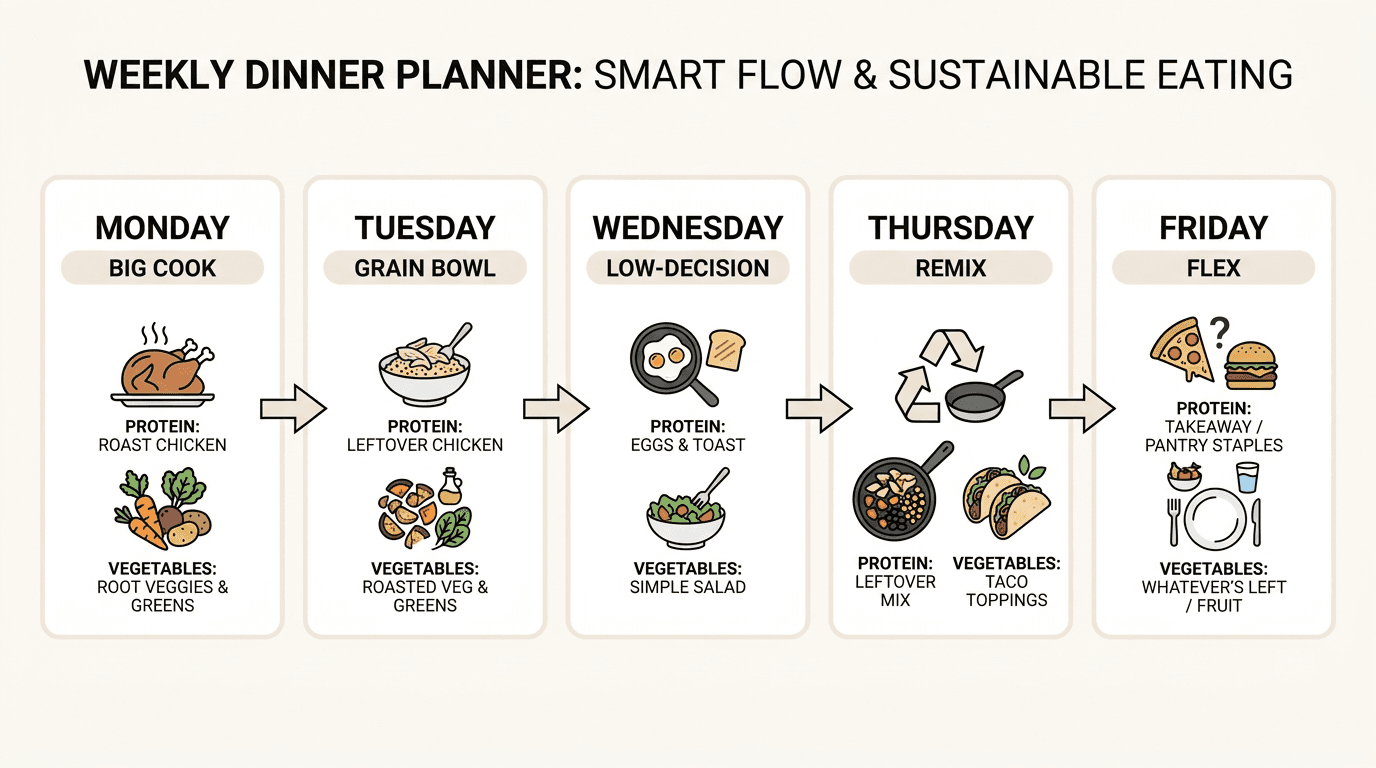
Monday and Tuesday: cook while you still have momentum
If Monday tends to be one of your higher-energy evenings, use it for the week’s more involved cook; the week still feels containable, and whatever you make can be engineered to carry into Tuesday. Lemongrass chicken with jasmine rice on Monday, for example, turns into Tuesday grain bowls with a different sauce and whatever vegetables are around. Tuesday is a good place for fast, high-protein meals: stir-fries, grain bowls, quick noodles. The win is flexibility: you can adjust portions, proteins, grains, and sauces to better match your nutrition goals without starting from zero.
Wednesday: design for the night that breaks most plans
Wednesday is often where an ambitious weekly dinner plan starts to feel harder to follow. The move is to admit that in your plan instead of hoping you will power through. Give Wednesday a low-decision dinner: dal, soup, pasta, something that mostly takes care of itself. This is where the Posha cooking system fits cleanly into the week.
Before the evening gets busy, you prep and load the ingredients, start the dal tadka, and walk away. Posha is not just about getting dinner started. It watches, adjusts, and moves through each cooking step with chef-like precision while you focus on the rest of your evening. Forty minutes later, cumin and tomato are already in the air. That is why Wednesday can become easier with a cooking system that handles the active steps of dinner. For more easy dinners that fit a weeknight, the same pattern shows up across cuisines.
Thursday and Friday: the remix and the release valve
Thursday is leftover remix night, but not the sad version where you reheat the exact same plate and call it a plan. One new element, a different sauce, a fresh grain, even a fried egg on top, can make Monday's protein read as a different dinner. Friday is flex night: takeout, a simple sheet pan, whatever sounds right. Putting that in the plan is not quitting. It is the release valve that keeps the rest of the week from turning into an all-or-nothing mess.
A meal plan template you can actually reuse
Night | Energy Tier | Dinner Type | Protein Slot | Vegetable Slot | Carries Forward To |
|---|---|---|---|---|---|
Monday | High | Protein-forward cook | Chicken thigh/salmon/lentils | Roasted or sautéed seasonal veg | Tuesday grain bowl base |
Tuesday | Medium | Grain bowl or stir-fry | Leftover Monday protein | Quick-cook greens or frozen veg | Optional: sauce for Thursday |
Wednesday | Low | Hands-off simmer (dal, soup, pasta) | Legumes/pantry protein | Wilted greens or canned tomato | Lunch next day |
Thursday | Low-Medium | Leftover remix | Monday or Tuesday protein | One fresh element added | None needed |
Friday | Flex | Takeout/sheet pan | Your call | Your call | N/A |
To keep this template feeling fresh, rotate the protein slot across three or four weeks: salmon one week, chicken thigh the next, lentils the week after. The structure stays the same; the meals change. Treat the template like scaffolding, not a script. Its job is to erase the blank-page feeling on Sunday, not to micromanage every bite. If you want a bigger menu to pull from, weekly meal ideas organized by dietary approach can help you fill the protein slot without reinventing the week.
Weekly meal prep: what to actually do on Sunday
The classic mistake is trying to prep everything on Sunday, which turns into a three-hour kitchen marathon and then a quiet abandonment by week two. In a 2022 survey of 3,142 U.S. adults, 44% reported meal prepping regularly, and Sunday was the most popular prep day. The goal is not restaurant-level mise en place. Aim for four components in 45 minutes that make three weeknight dinners easier.
A realistic Sunday session:
Cook one grain (rice, farro, or quinoa) in bulk
Prep one sauce base or marinade for Monday's protein
Wash and dry greens so they are ready to grab
Portion one pantry protein (dried lentils measured, canned beans drained)
Skip anything that is better fresh (avocado, soft herbs, dressed salads) and anything that takes longer to reheat than it would to cook on the spot. Posha has more component-based meal prep ideas for building a flexible week without repeating the same meal.
How Posha holds the plan when your energy does not
Posha's intelligence watches cooking progress, adjusts settings, and makes decisions at each step, similar to how a chef adapts while cooking. Dal tadka needs time and stirring. Tomato bisque needs the heat eased at the right moment. On a Wednesday when neither partner has much left, those well-timed adjustments are often the difference between dinner happening and dinner quietly not happening.
Posha's Culinary AI keeps an eye on cooking progress, senses changes such as color and texture, and helps the system decide when to adjust the cooking process. On Thursday, choose a fresh recipe that uses some of the prepped components, load the ingredients, and let it manage the cooking steps. For a fuller picture across a real week, the guide to healthy home-cooked meals for busy families walks through the same framework in more detail.
Dinner planning for health goals without the spreadsheet
If you track macros or read labels, the less exhausting approach is to bake nutrition into the template instead of obsessing over each recipe. When Monday is always lean protein plus grain plus vegetables, that structure can make meals easier to plan consistently, while portions and ingredient choices still determine the actual macros. Start with the protein anchor: pick the week's proteins first (salmon, chicken thigh, lentils, eggs), then build the rest around them. A study of 40,554 French adults found that meal planning was associated with better diet quality, greater food variety, and lower odds of obesity, although the observational study does not establish causation. The structure is doing more nutritional work than any single heroic recipe.
Posha's app can reduce the decision load without locking your household into a fixed menu. You can plan meals and groceries, customize recipes for dietary preferences, allergens, and spice levels, and swap ingredients based on what you have. Browse healthy dinner ideas to build a rotation around your actual goals.
What separates a plan that holds from one that does not
Plans that last are usually the ones with the fewest decisions per night, not the ones that look perfect on paper. Every choice you remove on a Tuesday evening is energy you get to keep. One grocery habit that pays off fast: make sure at least two ingredients show up in three or more dinners each week. Cooked farro, a jar of tahini, a rotisserie chicken. Overlap shortens the list and makes the week feel lighter.
Note: Edge case protocol: when one partner travels, when you are sick, when the week goes completely sideways, the plan needs a fallback, not just a normal-week version. Keep two "emergency dinners" in permanent rotation: one pantry-only (pasta e ceci, fried rice), one that works with simple ingredients and a short prep-and-load step (a lentil soup, a simple curry). These are not failures. They are the reason the plan exists.
A plan you follow four out of five nights beats a perfect plan you drop by Tuesday. Perfection is the enemy of the weekly dinner planner. The American Heart Association reports that shared meals can support connection and stress reduction, even when households start small. Four nights count.
Frequently Asked Questions
How many dinners should I plan each week, and is five realistic?
Five is a useful structure, as long as one of those nights is flex from the start. In practice, you are planning four dinners with intention and leaving Friday open. That is not settling; it is what makes the other four nights happen. A weekly meal planner that includes the nights you will not cook holds up better than one that assumes you always will.
What is the difference between a weekly meal planner and a meal prep plan, and do I need both?
A weekly meal planner is the architecture: which dinner types land on which nights, which proteins anchor the week, which meals share ingredients. A meal prep plan is the labor: what you do on Sunday to make the week easier. You want both, but they are separate activities. When you mash them together, Sunday turns into a three-hour session, and people burn out. Plan first, then choose the smallest prep that saves you time midweek.
How do I handle two people with different dietary goals in the same weekly dinner plan?
Use protein anchors and keep dinners modular. A grain bowl base works for someone tracking protein and someone eating plant-forward at the same time. Decide the shared components (grain, roasted vegetables, sauce), then let each person customize the protein portion. The template works best when the base stays neutral, and the personalization happens in the protein slot.
How far in advance should I do weekly meal planning, Sunday or earlier?
Sunday works for most households because it is close enough to the week to feel concrete. If you can spare ten minutes on Thursday or Friday to scan the template and confirm protein anchors, Sunday becomes filling in details instead of starting from scratch. The aim is simple: no blank page on a weeknight.
Can I use the same weekly dinner planner template every week, or should it change?
Keep the structure; rotate the proteins. Swap the protein slot across three or four weeks (salmon, chicken thigh, lentils, eggs), and the dinner types will produce a different set of meals each time. As the routine becomes familiar, filling in the template should take less time, which is the point.
The plan that actually makes it to Friday
The framework is straightforward: energy-tiered nights, a reusable template, minimal Sunday prep, and one flex night that is there on purpose. The biggest shift is stopping the attempt to schedule specific meals and instead scheduling dinner types. Once the structure is set, recipes slide into place without a fight.
Grab the template, map your week's energy with honesty, and choose your proteins. Week one is the clunkiest because you are building the habit. Once the routine becomes familiar, it becomes a quick Sunday reset. And on a Wednesday when neither of you has much left, a system that watches, adjusts, and moves through each cooking step means dinner is already underway, cumin in the air, without another decision waiting for you. That is what a well-designed weekly meal planner actually delivers: a structure that forgives, a little preparation, and a system that holds when you cannot. For dinner ideas for when you do not want to cook, the plan covers that mood, too.