Rohin Malhotra
You know how it goes. Monday morning, you and your partner are motivated: the fridge is stocked, the plan is taped to the door, and dinner is definitely going to be grilled chicken with roasted vegetables. By Wednesday, one of you is stuck at work, the other forgot to defrost the salmon, and suddenly you are splitting a pizza on the couch asking, "How did we get here?" A meal plan for weight loss rarely falls apart because you are weak. It falls apart because it was never designed around your real week.
This is not another set of 1,200-calorie days that leaves you hungry and annoyed by Thursday. It is a flexible, home-cooking routine that respects your schedule, your preferences, and the fact that weeknights can get messy fast. You will get a simple plate-building formula, a 7 day meal plan template, and practical ways to make the plan stick, including how smart kitchen technology can quietly take over the portioning details that trip up a lot of couples.
Step 1: The 'Why' Before the 'What'
Most weight loss meal plan guides sprint to the grocery list. That is backwards. If you do not understand why the plan works, you will drop it the first time life gets loud. The point of a weekly plan is not to clamp down on your food. It is to cut decision fatigue. Every night you stand in front of the fridge asking, "What should we make?" is a night that ends with delivery apps doing the thinking for you.
Under the hood, the nutrition goal is simple: a gentle calorie deficit. According to Harvard Health's calorie guidance, eating 500 to 1,000 fewer calories than your daily maintenance level supports a loss of about 1 to 2 pounds per week, which the CDC identifies as a safe, sustainable rate. Home cooking makes that feel doable without turning dinner into a math quiz, because you control the oil, the portions, and the ingredients. You do not need to weigh every gram of rice. You need a repeatable system that keeps putting a reasonable amount of food on a reasonable plate.
Even a 5% reduction in body weight for someone who is overweight can improve blood pressure, cholesterol, and blood sugar levels, according to the Centers for Disease Control and Prevention. That's often just 8 to 12 pounds. Small, consistent changes add up faster than dramatic ones.
Step 2: Building Your Plate, the 3 Pillars of Satisfying Calorie Deficit Meals
Skip the endless lists of "good" and "bad" foods. For dinner (and, honestly, lunch too), you are aiming for the same visual pattern every time. Once this clicks, you can build a satisfying meal from whatever is already in the fridge, whether that is a Mediterranean bowl or a comforting plate of dal and roti.
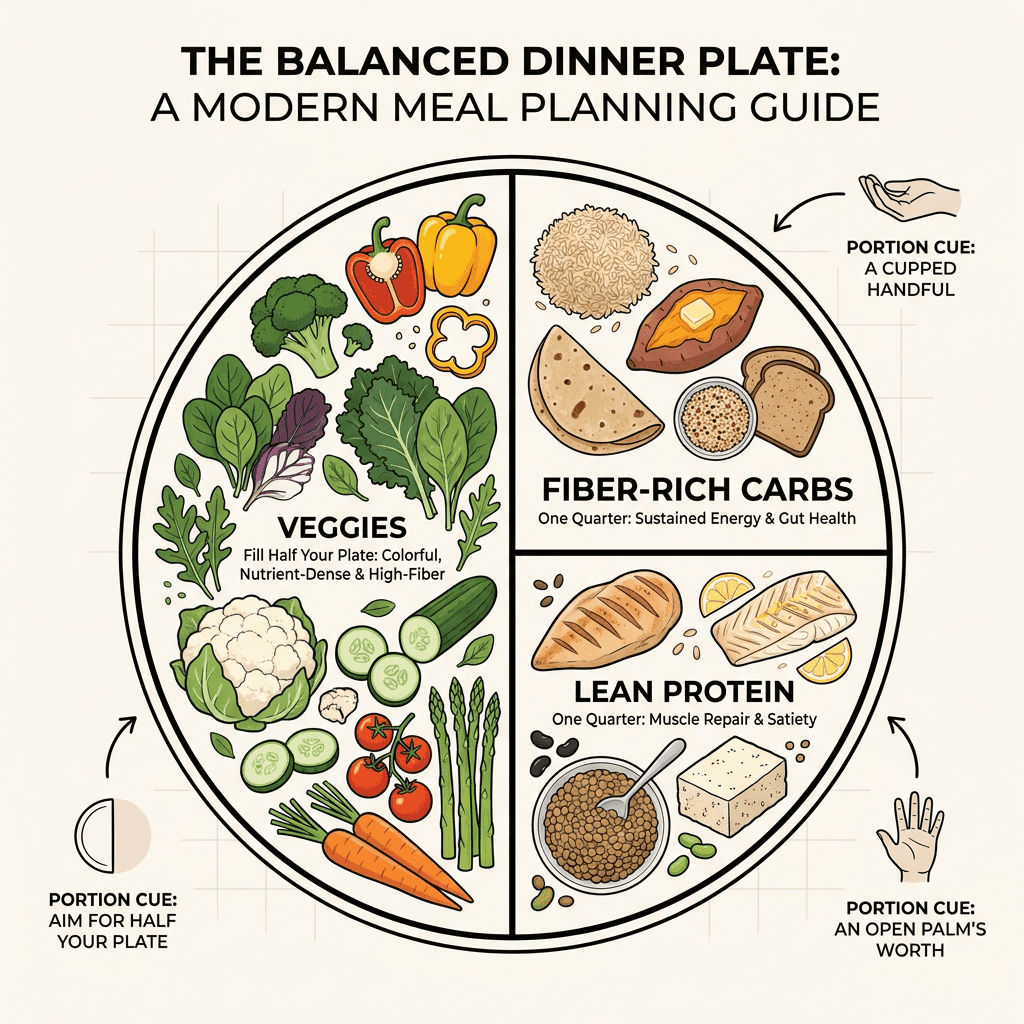
Half your plate veggies, a quarter protein, a quarter fiber-rich carbs — every meal, every time.
Pillar 1: Lean Protein Power
Protein helps you stay full longer and hang onto muscle while you are in a deficit. For most meals, a palm-sized portion is a solid cue. Good options include chicken breast, fish (salmon, tilapia, cod), tofu, lentils, eggs, and Greek yogurt. If you and your partner prefer different proteins, that is not a problem. Keep the structure and let the ingredients vary.
Pillar 2: Fiber-Rich Carbs
Carbs are not the villain. The slow, fiber-rich kind gives you steadier energy and helps avoid the blood sugar crash that turns into late-night snacking. Reach for quinoa, brown rice, sweet potatoes, oats, and whole-wheat roti. Use a cupped handful as your portion cue. You will also notice the 7 day meal plan below keeps carbs in the mix every day, because the plan you can live with beats the plan you white-knuckle for a week.
Pillar 3: Volume from Veggies
This is how you make fewer calories feel like plenty of food. Vegetables are nutrient-dense and low in energy density, which means you can eat a lot for relatively few calories. Aim for at least half your plate: leafy greens, broccoli, bell peppers, cauliflower, zucchini, bhindi (okra), or whatever you actually like. Roast them, stir-fry them, fold them into a sabzi. More color usually means you are covering more micronutrients without trying too hard.
Step 3: Your Flexible 7-Day Meal Plan Blueprint
Below is a healthy weekly meal plan built with busy couples in mind. Every dinner follows the 3-pillar plate. The "Pro Tip" column is where the time savings live: planned leftovers, batch cooking, and a few shortcuts that keep weeknights from unraveling. Treat this as a template. Swap proteins, rotate vegetables, change the spice profile. Keep the pattern.
Sample Weight Loss Dinners for the Week
Day | Dinner Idea | Pro Tip / Hack |
|---|---|---|
Monday | Lemon Herb Salmon with Quinoa & Roasted Asparagus | Make extra quinoa. Bank the leftovers for Wednesday's grain bowl. |
Tuesday | Turkey & Black Bean Stuffed Bell Peppers | Do the filling on Sunday. Weeknight you just assemble and bake (about 25 minutes). |
Wednesday | Chicken Grain Bowl with Leftover Quinoa, Cucumber & Tahini | Short on time? Rotisserie chicken keeps the plan intact. |
Thursday | Masoor Dal & Bhindi Sabzi with 1-2 Whole Wheat Rotis | Posha can run the dal and sabzi at the same time and auto-adjust cook times. |
Friday | Shrimp Stir-Fry with Brown Rice & Snap Peas | Frozen shrimp thaws in 10 minutes under cold water. Keep it easy. |
Saturday | Slow-Cooked Chicken Tikka with Cauliflower Rice | Marinate in the morning. Let cook time do the heavy lifting. |
Sunday | Veggie-Loaded Frittata with Mixed Green Salad | Clear the fridge: fold in leftover vegetables and waste less. |

Thursday's dinner from the 7-day plan: masoor dal, bhindi sabzi, rotis, and raita.
Take Thursday as proof of concept. Masoor dal with bhindi sabzi and a couple of rotis is warm, filling, and naturally structured for portion control, with plenty of plant protein and fiber built in. Weight loss dinners do not have to look like a sad salad. They can look like the food you actually want to sit down and eat.
Step 4: From Plan to Plate, Making It Real
Meal planning is a key strategy for weight loss because it simplifies shopping and pushes you toward nutrient-dense foods, but couples usually get stuck in the doing.
The Weekend Reset: Your 90-Minute Prep Session
Choose a 90-minute window on Sunday (or whatever day makes sense). Put on a podcast. Pour some coffee. Then run through these five tasks:
Wash and chop vegetables for Monday through Wednesday. Store in airtight containers with a damp paper towel.
Batch cook one grain. Quinoa, brown rice, or a pot of dal. This becomes the base for multiple meals.
Marinate proteins. Tuesday's turkey filling, Thursday's chicken tikka. Ten minutes of work saves 30 minutes on a weeknight.
Portion snacks. If you're keeping nuts, fruit, or yogurt on hand, pre-portion them into individual servings now.
Review the week's plan together. Confirm who's cooking which nights. Shared ownership prevents the "I thought you were handling dinner" spiral.

A 90-minute Sunday reset makes portion-aware weeknight cooking far less stressful.
The Technology Assist: How Automation Solves the Portioning Problem
Most weight-loss advice skips an awkward truth: portion control is tedious. It is also easy to "eyeball" your way into bigger servings without noticing. You make a pot of dal for two, and both bowls end up heaping. You free-pour olive oil and accidentally double what the recipe asked for. Those little extras stack up and can quietly stall progress.
That is where the Posha Robot Chef can earn its keep. You choose from Posha's recipe library, which includes meals across cuisines, diets, and nutrition profiles, with per-serving nutrition shown for many recipes. Once you prep and load the ingredients, Posha helps automate the repetitive parts of cooking: stirring, timing, heat control, and adding ingredients at the right stages. Making Thursday's masoor dal? Posha can help take over the hands-on monitoring that usually keeps you tied to the stove, making it easier to cook a fresh, calorie-aware dinner at home. For couples trying to stay consistent with a weight-loss meal plan, that means less measuring, less second-guessing, and less temptation to abandon the plan when the week gets busy.
What Most People Get Wrong About Weight Loss Dinners
After coaching dozens of couples through their first few weeks of home cooking for weight loss, the same three mistakes keep showing up.
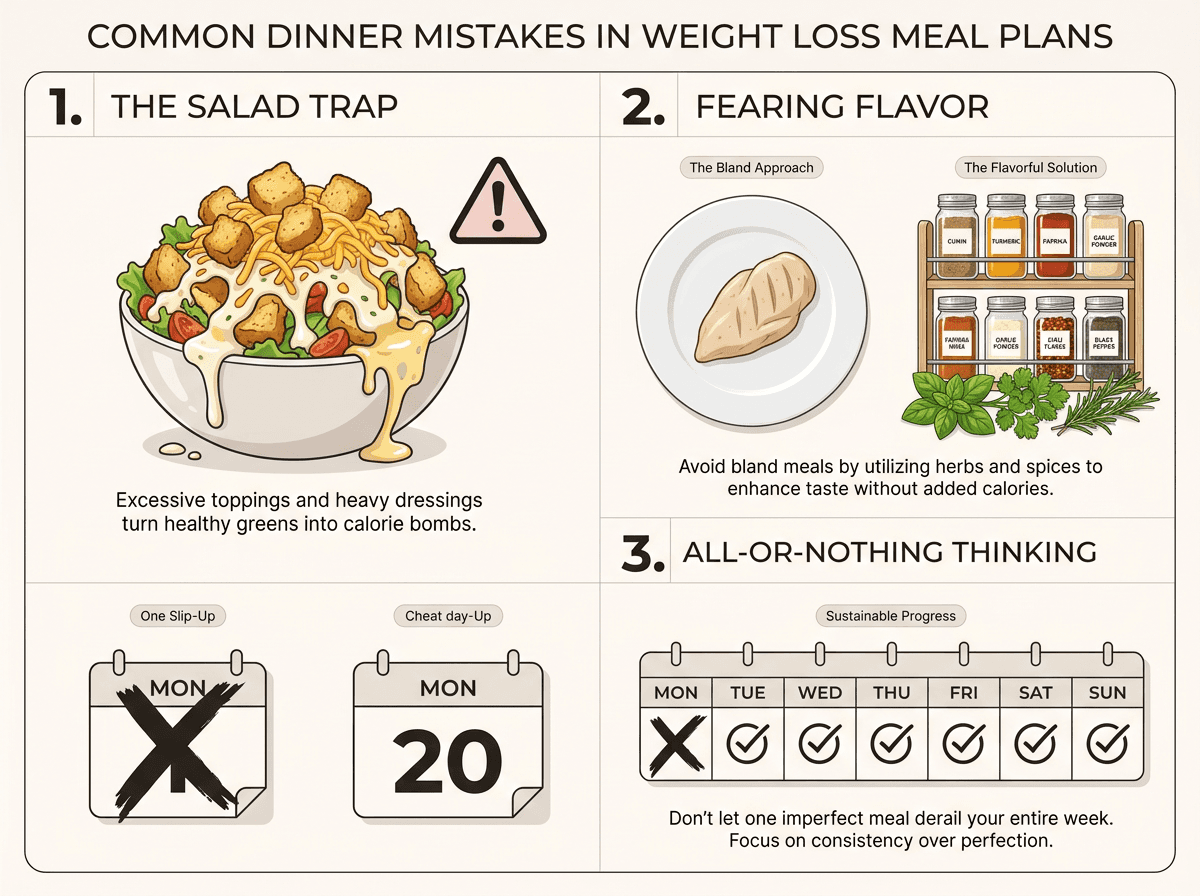
From salad overload to all-or-nothing thinking — these three mistakes quietly derail most weight loss dinner plans.
Mistake 1: The Salad Trap. A salad is not automatically "healthy." Pile on creamy ranch, shredded cheese, candied nuts, and croutons and you can end up with a 900-calorie bowl that still leaves you hungry an hour later. Meanwhile, a warm plate of dal and sabzi with roti can come in lower, bring more protein and fiber, and keep you satisfied until morning. "Healthy" is about how the meal is built, not how it photographs.
Mistake 2: Fearing Flavor. Spices and herbs are basically calorie-free, yet people strip meals down to steamed chicken and plain broccoli and then act surprised when they cannot stick with it. Cumin, turmeric, smoked paprika, fresh cilantro, garlic, ginger: these are the difference between "diet food" and dinner you look forward to. Posha can toast whole spices and build sauces automatically, so "I don't know how to cook Indian food" stops being the thing that blocks you.
Mistake 3: All-or-Nothing Thinking. Takeout on Wednesday does not mean the week is blown. A healthy weekly meal plan is about consistency across weeks and months, not perfection inside a single day. If dinner ran big, make lunch lighter tomorrow. If prep did not happen, simplify the next two dinners to scrambled eggs with sauteed veggies. Progress is not linear, and guilt does not cook anything.
Personalizing Portions and Swaps for Your Household
Rigid meal plans often fail couples for a simple reason: two people rarely need the same amount of food. If one partner is 5'2" and the other is 6'1", identical portions are a mismatch from the start. The healthdirect guide on weight loss and dieting emphasizes that sustainable plans focus on the right food groups in appropriate amounts, not one-size-fits-all calorie targets.
Here is the practical move: keep the plate formula from Step 2, then adjust the carb and protein by one "unit" for the partner with higher needs (one extra cupped handful of rice, a slightly larger palm of chicken). You are still cooking one dinner, not running a short-order kitchen. Posha can streamline this further by letting you set individual serving sizes within the same recipe. Choose "2 servings, adjusted" and it recalculates ingredient quantities so each plate is right-sized. No second pot. No awkward splitting.
Swaps follow the same logic. Allergic to shrimp? Use chicken for Friday's stir-fry. Prefer paneer over tofu? Go for it. Keep the 3-pillar ratio steady and rotate the specific foods as needed. Posha also adjusts cook time when you swap ingredients, which helps you avoid rubbery paneer in a recipe that was tuned for tofu.
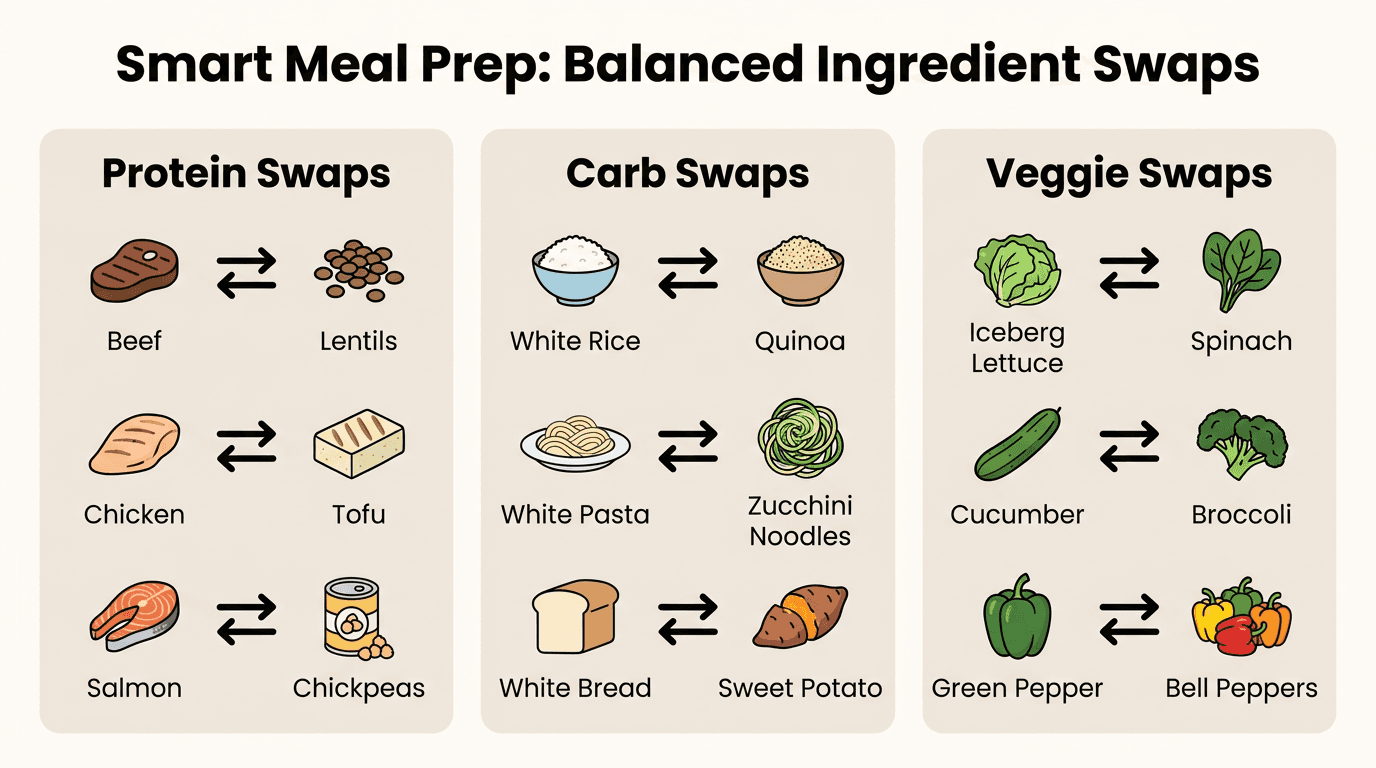
Keep the 3-pillar ratio steady and rotate ingredients freely within each column.
Frequently Asked Questions
What if I don't like some of the foods in the meal plan?
Swap them without guilt. This plan is a template, not a rulebook. Do not like salmon? Use chicken or tofu. Hate quinoa? Brown rice or sweet potato fits just as well. Keep the 3-pillar ratio (protein, fiber-rich carb, vegetables) and pick foods you will actually eat. Posha makes swaps simpler by auto-adjusting cook times when you change an ingredient, so dinner still comes out right.
How many calories is this meal plan? Do I need to count them?
There is no single calorie number here because your needs depend on age, height, activity level, and goals. Harvard Health (2024) suggests a deficit of 500 to 1,000 calories below your maintenance level for steady weight loss. Instead of tracking every bite, this plan leans on portion cues (palm, cupped handful, half-plate of veggies) and home cooking to keep you in a gentle deficit. If you want tighter precision, a registered dietitian can help you set a personalized target.
Can I still have snacks or dessert on this plan?
Yes. A square of dark chocolate, fruit with yogurt, a handful of almonds: all of that can fit. The goal is a consistent calorie deficit across the week, not "perfect" meals every time. Pre-portioning snacks during your Sunday prep makes it easier to enjoy them without drifting into mindless extra servings.
What if I'm cooking for one person instead of a couple?
The structure stays the same. Halve recipes, or batch cook and store single portions for later in the week. Posha lets you select single-serving quantities, so you get precise amounts without ending up with a fridge full of leftovers you did not plan for.
I'm vegetarian or vegan. Can I still use this meal plan?
Yes. Swap animal proteins for lentils, chickpeas, tofu, tempeh, or paneer (for vegetarians). Thursday's masoor dal and bhindi sabzi is already fully plant-based. The 3-pillar approach does not care where your protein comes from, so the framework adapts to your preferences without losing its shape.
Your First Week Starts Now
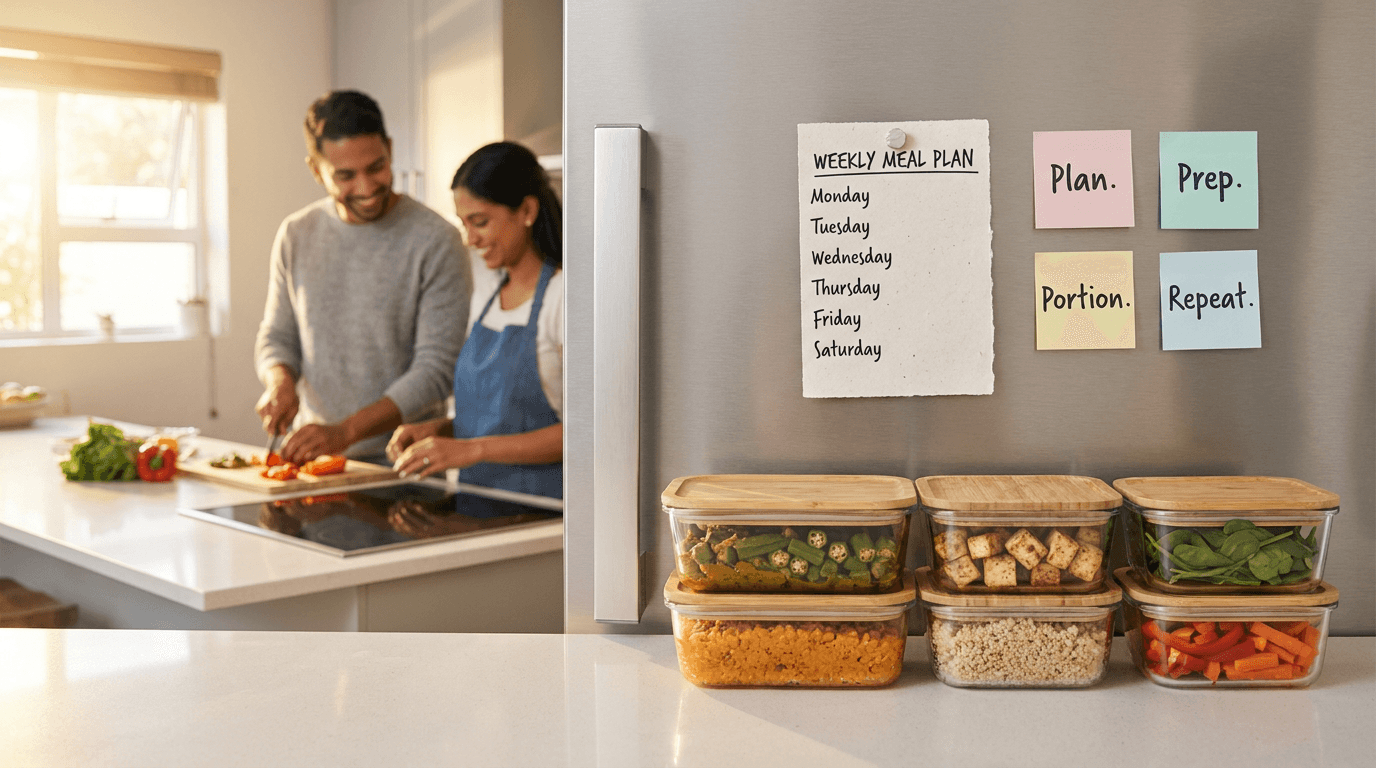
One dinner this week is all it takes — plan, prep, portion, repeat.
This whole approach fits on a sticky note: Plan. Prep. Portion. Repeat. A meal plan for weight loss works because it removes the nightly decision that usually ends in takeout. You have the plate formula. You have a flexible 7 day meal plan. You know the three traps that tend to derail people. Now it is just time to put one meal on the calendar and follow through.
Choose one dinner from the table and cook it this week. Just one. If Thursday's masoor dal and bhindi sabzi is calling your name, start there. If you want the full downloadable plan with recipes, a grocery list, and portion guides for two, grab it from the opt-in above. And if portioning guesswork has been quietly adding calories back into your meals, take a look at how the Posha Robot Chef personalizes recipes to your exact serving size. Keep the first step small. Small is how routines stick.