Rohin Malhotra
A medium raw carrot lands around 4 grams of net carbs, which is why carrots keep showing up in keto debates. They are not a freebie, but they are also not going to blow up your day on their own. What matters is simple: does the portion you actually eat fit your carb budget?
If you track macros on keto, carrots sit in the awkward middle of the vegetable world. They are sweeter than leafy greens and more carb-dense than cucumber, but they are nowhere close to potato territory. Once you know the numbers, you can use carrots on purpose instead of cutting them out by default.
How Many Carbs Are Actually in Carrots?
It all comes down to amount, and most people are surprisingly bad at eyeballing a "handful." One medium raw carrot (about 61 grams) has 6 grams of total carbohydrates and 2 grams of fiber. Take fiber out of the equation and you get 4 grams of net carbs. For many low-carb plans, that is workable if you keep it to one carrot.
Move up to a full cup of chopped raw carrots (about 122 grams) and the math gets less forgiving. That serving comes in at 12 grams total carbs, 3 grams fiber, and 9 grams net carbs. If you are running strict keto at 20 to 25 grams of net carbs a day, one cup of carrots can eat up close to half the allowance. This is where measuring beats guessing.
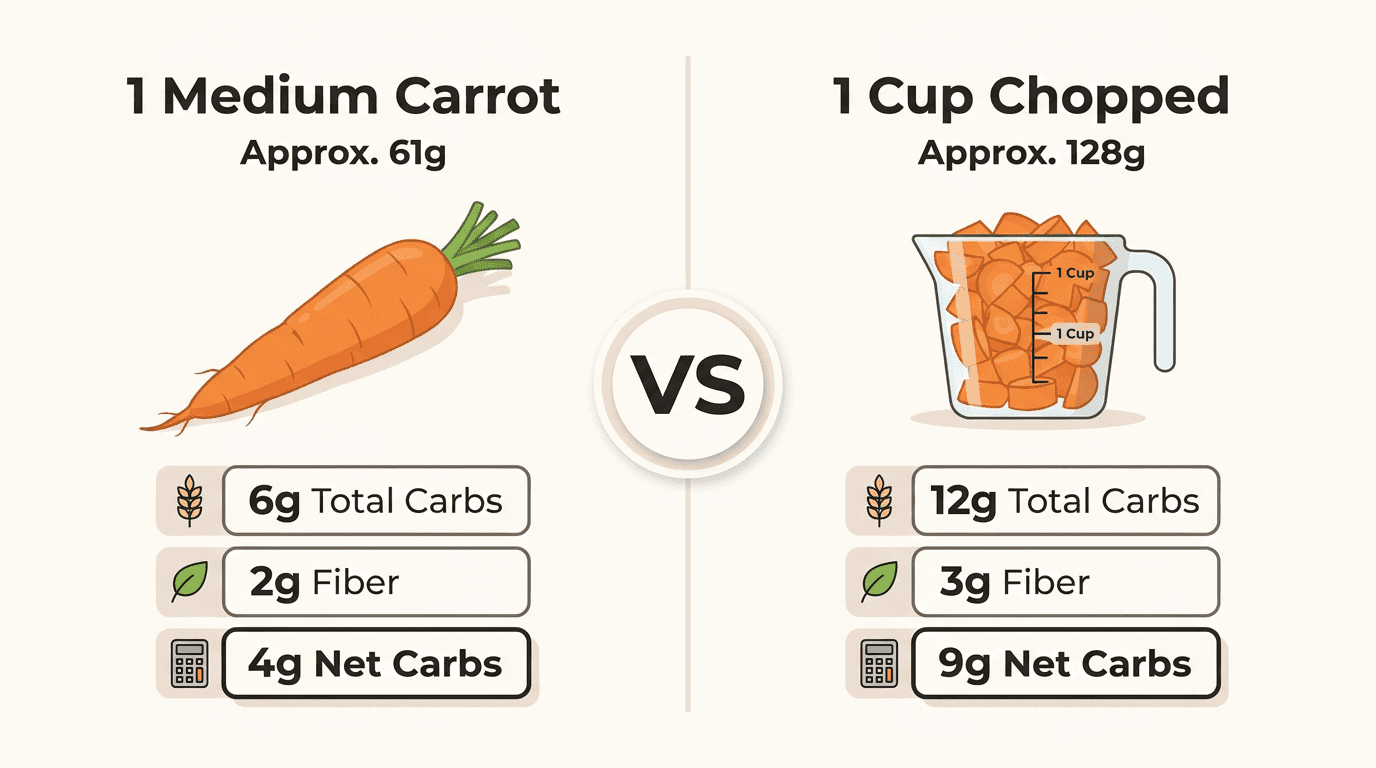
Portion size matters — one cup of chopped carrots nearly triples the net carbs of a single medium carrot.
Does Cooking Change the Carb Count?
Cooking does not change how many carbohydrates are in a carrot. What it can change is how fast those carbs hit your system, which is the part keto dieters tend to care about. Raw carrots have a glycemic index around 16, which is very low. Boiled carrots can rise to a GI between 32 and 49: still considered low, but clearly higher than raw. Cooking methods affect carrot blood sugar impact because heat breaks down cell walls and makes the carbs easier to access during digestion.
So if blood sugar steadiness is your goal, keep carrots raw or cook them just until tender. Let them go soft-boiled or puree them and you are speeding up the response. Roasting until deeply caramelized can push things in the same direction, since moisture cooks off and the natural sugars concentrate. A quick saute or a short steam is usually the better tradeoff.
Are Carrots Keto? The Honest Answer
Yes, carrots can fit on keto, but only if you treat the serving size like it counts. The ketogenic diet commonly lands at 20 to 50 grams of net carbs per day, depending on the person. One medium carrot at 4 grams net can slide into that range without drama. The trouble starts when carrots turn into a snack pile or disappear into soups and stews where nobody measured anything.
It also helps to place carrots in the right bucket. They are root vegetables, which is not the same thing as tuber vegetables like potatoes. Carrots store energy in the root, but they are not the dense, starchy package you get with a potato, so the carb load is much lower. That difference matters when you are comparing carbs in vegetables at the produce shelf.
Diet Doctor's visual guide to low-carb vegetables puts carrots in the "eat with moderation" lane for strict keto, and that is about right. They are not in the spinach-and-zucchini tier, but they are not banned either. Call it a measured yes: you can have them, just with a deliberate portion.
How Do Carrots Compare to Other Low Carb Vegetables?
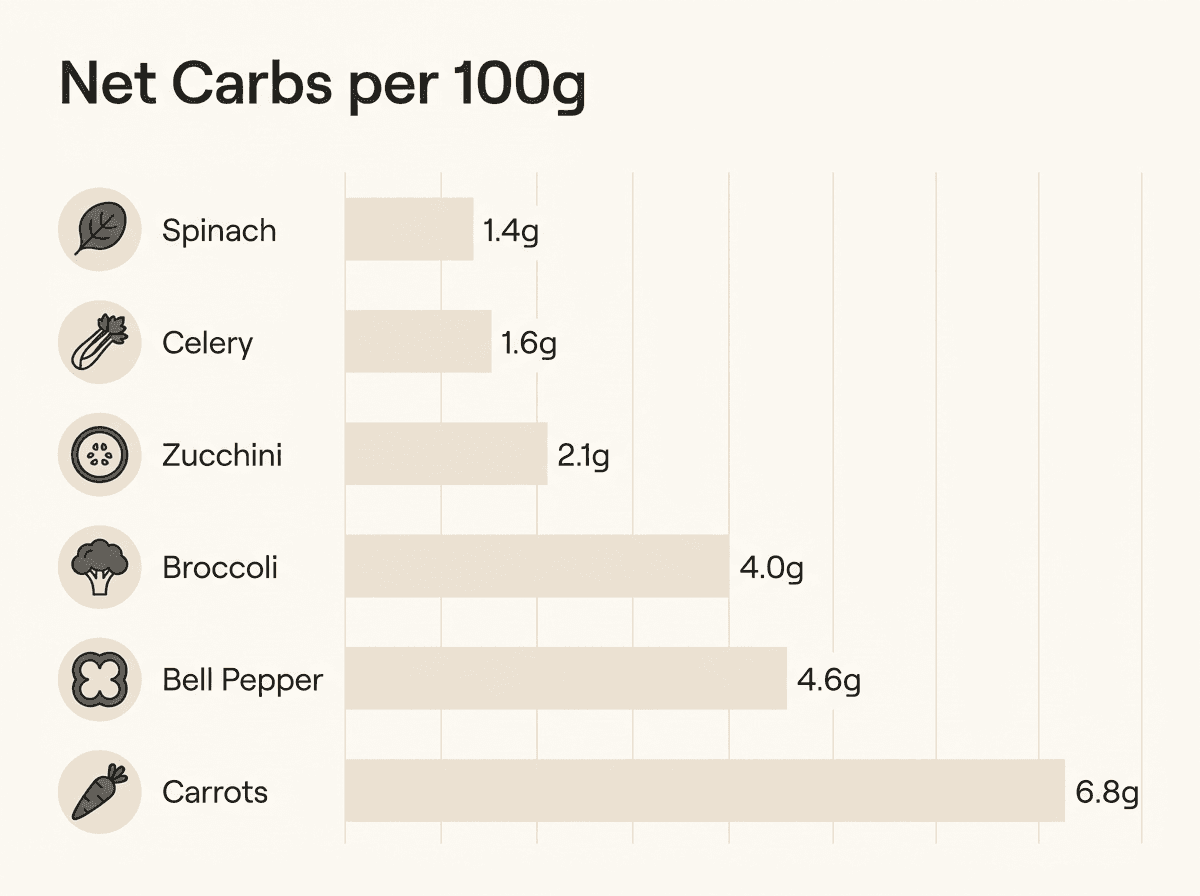
Among common keto vegetables, carrots carry significantly more net carbs per 100g.
A quick comparison shows why carrots get the side-eye. Spinach comes in under 1 gram of net carbs per cup. Zucchini is around 2.5 grams per cup. Broccoli is close to 4 grams per cup. Carrots, at about 9 grams net per cup, are meaningfully higher than the usual keto standbys, which is why they are a "use sparingly" vegetable, not an "eat freely" one. They sit near the top end of what most people call low carb.
None of that makes carrots nutritionally empty. They bring beta-carotene, potassium, and vitamin K1. And if you are doing a looser low-carb plan (more like 50 to 100 grams of net carbs per day), carrots can move from "occasional" to "regular" without much stress.
Common Misconceptions About Carrots and Keto
"Carrots are too sweet for keto." Sweet taste is not a carb count. Carrots taste sweet because they have natural sugars, but the net carbs per serving are still moderate. A tablespoon of heavy cream carries more calories than a medium carrot, yet cream rarely gets labeled a keto problem. Go by net carbs per serving, not your tongue.
"Baby carrots are lower in carbs than regular carrots." Baby carrots are regular carrots cut down and shaped. The carbs per gram do not magically change. What does change is how easy they are to mindlessly snack on, since a bag of baby carrots can vanish faster than a whole carrot on a cutting board.
"Cooked carrots are off-limits on keto." Cooking can raise the glycemic index, but it does not add carbs. A cooked carrot and a raw carrot of the same weight have the same net carbs. The real concern is speed of blood sugar response, not the total carb number. For most people staying in ketosis, a small amount of cooked carrot in a dish is not going to wreck anything.
How to Cook Carrots the Smart Way on a Low-Carb Diet
The easiest way to keep carrots keto-friendly is to treat them like seasoning, not the main event. A few thin slices in a broth-based soup add sweetness and a little body without taking a big bite out of your carb budget. A small handful of julienned raw carrot in a salad gives you crunch and color for far fewer carbs than a full cup.
If you want carrots on the side, keep the portion small and cook them to just-tender instead of soft. The Posha Robot Chef aims for that kind of doneness by reading carrots the way an experienced cook would: it tracks how size and density change as heat moves through the vegetable, then adjusts timing instead of blindly following a fixed clock. That size-aware approach helps you avoid cooking carrots down into a softer, higher-GI texture.
Practical rules for using carrots on keto:
Cap a serving at one medium carrot or about 1/4 cup chopped.
Choose raw or lightly cooked carrots to keep the glycemic index lower.
Log carrots in your daily net carbs instead of treating them like a free vegetable.
Eat them with fat (olive oil, butter, tahini) to further slow glucose absorption.
Skip pureed or heavily caramelized carrots if blood sugar stability is a concern.
Key Takeaways
What to remember about carbs in carrots on keto or low carb:
One medium raw carrot has 4 grams of net carbs. One cup chopped has 9 grams.
Raw carrots have a low glycemic index (around 16). Boiled carrots rise to 32 to 49, still low but higher.
Carrots are root vegetables, not tubers, making them lower in carbs than potatoes.
Carrots on keto are fine in small, measured portions. They are not a free food.
Among low carb vegetables, carrots sit near the upper limit. Use them as an add-in, not a base.
Cooking method changes blood sugar response. Lightly cooked beats fully softened.
Carrots nutrition includes beta-carotene, potassium, and vitamin K1, making them worth the carb cost in moderation.

Carrots work on a keto plate — measured as a garnish, not the main event.
Frequently Asked Questions
How many net carbs are in a serving of carrots?
One medium raw carrot (about 61 grams) has 6 grams of total carbs and 2 grams of fiber, which works out to 4 grams of net carbs. A full cup of chopped raw carrots is 9 grams of net carbs. When you are tracking net carbs, the serving size is what decides whether carrots fit.
Are carrots keto-approved?
They can be, if you measure. One medium carrot usually fits inside a strict keto budget. The common mistake is overeating them, especially with baby carrots or when carrots are mixed into soups and stews and the quantity is hard to see. Measure before cooking, not after.
Are carrots better or worse than other low carb vegetables for keto?
They are higher in net carbs than many keto staples like spinach, zucchini, and celery. They are still a better pick than starchy vegetables like corn or peas, and far better than potatoes. On a keto plate, carrots make the most sense as an occasional add-on rather than a daily base vegetable.
Does cooking carrots increase their carbs?
No. Cooking does not add carbohydrates, so a cooked carrot and a raw carrot of the same weight have the same net carbs. What changes is the glycemic index, meaning cooked carrots can raise blood sugar faster than raw ones. For keto, lightly cooked tends to work better than fully soft or pureed. See how cooking affects carrot blood sugar impact for more detail.
What is the best way to include carrots in a low-carb diet?
Use carrots as an accent, not the main vegetable. A few thin slices in broth, a small julienned portion in salad, or about 1/4 cup roasted alongside protein keeps the carb cost modest while still adding flavor and nutrients. Pair them with fat to slow glucose absorption, and count them in your daily carbs.